Why Your Knees Hurt Worse the Day After a Hard Workout (Not During It)
Quick Answer: Delayed knee pain after high-impact workouts is usually caused by microtrauma-triggered inflammation that peaks 24-48 hours later, not damage happening in the moment — which is why switching some sessions to low-impact movement reduces next-day pain without necessarily reducing fitness gains.
You finish a run or a jump-heavy class feeling fine, then wake up the next morning and your knees feel ten years older. That gap between the workout and the pain isn’t a coincidence — it’s your body’s inflammatory timeline playing out on a delay.

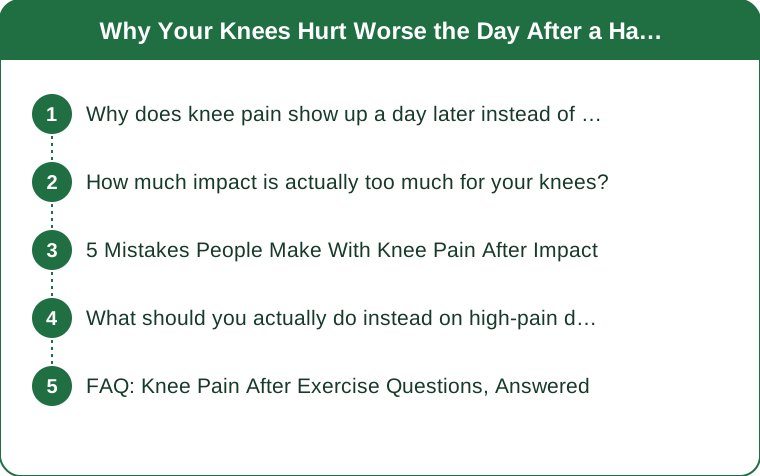
Why does knee pain show up a day later instead of immediately?
High-impact movement creates microscopic trauma in the tendons and cartilage-adjacent tissue around the knee. The inflammatory response to that trauma — swelling, fluid buildup, nerve sensitization — takes time to build, typically peaking 24-48 hours after the triggering activity, which is the same delayed mechanism behind muscle soreness (DOMS), just localized to a joint instead of a muscle.
How much impact is actually too much for your knees?
There’s no universal number, but a useful marker is tracking pain 24 hours out, not just during the workout. If a specific activity — running, box jumps, jump rope — reliably produces next-day knee pain while lower-impact versions of similar intensity don’t, that’s a signal your current volume of that specific movement exceeds what your knees can currently recover from, not that you need to stop moving altogether.

5 Mistakes People Make With Knee Pain After Impact
1. Pushing through it the next day — training on inflamed tissue extends the inflammatory window instead of letting it resolve. 2. Only stretching, never strengthening — quad and glute weakness is a bigger driver of knee strain than tight muscles for most people. 3. Icing for hours — 10-15 minutes is enough; longer doesn’t add benefit and can numb without healing. 4. Switching to zero impact permanently — some mechanical loading is what builds joint resilience; the goal is right-sizing impact, not eliminating it. 5. Ignoring footwear — worn-out shoes change impact distribution more than people expect.
What should you actually do instead on high-pain days?
Swap in low-impact cardio — cycling, swimming, or an elliptical — for 2-3 sessions a week to maintain fitness while impact-sensitive tissue recovers. Pair this with quad and glute strengthening (step-ups, wall sits, glute bridges), since stronger muscles around the knee absorb more force that would otherwise transfer directly to cartilage and tendons.
FAQ: Knee Pain After Exercise Questions, Answered
Is next-day knee pain always something to worry about?
Mild, dull soreness that fades within 48-72 hours is usually a normal adaptive response; sharp, localized pain or swelling that doesn’t improve within a few days warrants seeing a professional.
Does low-impact exercise really build the same fitness as high-impact?
For cardiovascular fitness, yes — heart rate and calorie burn can be comparable; for bone density specifically, some impact loading is still valuable in moderation.
How quickly can you rebuild impact tolerance?
Gradually reintroducing impact over 4-6 weeks, adding roughly 10% volume per week, is a commonly used and reasonably safe progression.
This is general information, not medical advice.
TL;DR:
- Delayed knee pain comes from an inflammatory response that peaks 24-48 hours after impact, not immediate damage
- Track next-day pain, not in-the-moment discomfort, to judge if impact volume is too high
- Strengthen quads and glutes — weak muscles transfer more force directly to the joint
- Swap 2-3 sessions a week for low-impact cardio during flare-ups rather than stopping entirely
Your knees aren’t betraying you overnight — they’re just running on a 24-hour delay you can plan around.
Keep Reading
This article is for general informational purposes only and is not medical advice. Always consult a qualified health professional for guidance specific to you.