How to Tell if Your Low Impact Training Is Actually Progressing
Quick Answer: Track the same session getting easier, not the session getting harder. The three most useful markers are heart rate at a fixed workload, how long you can hold a given effort, and how fast your heart rate drops in the first minute afterwards. All three improve with genuine fitness gains and none of them require adding impact, speed or load. Check them monthly on a repeatable test rather than reading day-to-day noise.
High impact training gives you obvious numbers. Faster mile, heavier squat, more rounds. Low impact takes those away and leaves you guessing.
Guessing is why people abandon low impact programmes that were working. Here is what to look at instead, question by question.

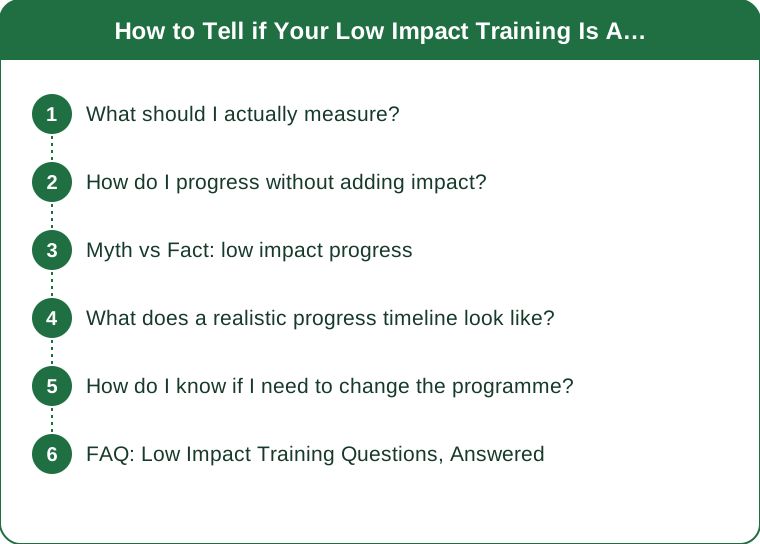
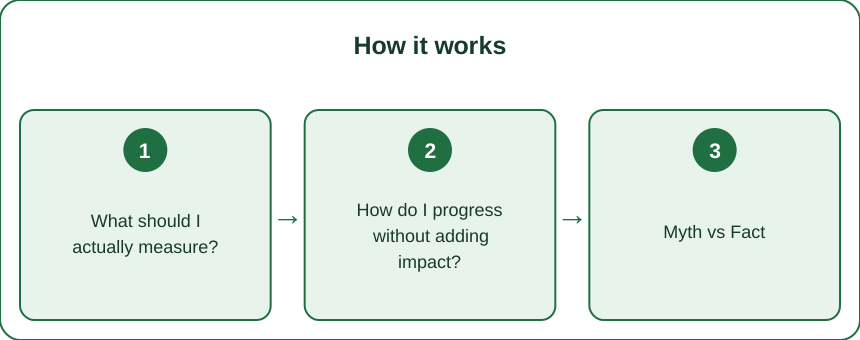
What should I actually measure?
Three things, all of which respond clearly to genuine improvement.
Heart rate at a fixed workload. Pick one repeatable effort: 10 minutes on the bike at a set resistance and cadence, or a fixed walking speed and incline. Note your average heart rate. As fitness improves, that number falls. A drop of 5 to 10 beats per minute over six to eight weeks at the same workload is a substantial improvement.
Duration at a fixed effort. How long you can hold a given intensity before form or breathing degrades. This is the low impact equivalent of adding weight to the bar.
Heart rate recovery. Measure your heart rate at the end of an effort, then again 60 seconds later. The size of that drop is one of the better markers of cardiovascular fitness available at home, and it improves noticeably with training.
How often should I test?
Monthly. Weekly testing produces mostly noise from sleep, heat, hydration and stress, and the noise is larger than the real monthly signal.
What if I do not have a heart rate monitor?
Use a talk test. Note the exact resistance level at which you can speak in short phrases but not full sentences. As you improve, that level rises at the same subjective effort.
How do I progress without adding impact?
There are more levers than people realise, and impact is only one of them.
Increase duration. The simplest. Add five minutes every two weeks until you reach your time ceiling.
Increase resistance or incline. On a bike, elliptical, rower or treadmill, this raises force demand without raising impact at all.
Increase density. Same work, shorter rest. This is one of the most effective and most underused progressions in low impact training.
Increase range of motion. A deeper step-up, a fuller squat, a longer stride. More range at the same load is more work.
Slow the tempo. A five-second lowering phase on a strength movement dramatically increases time under tension with no added load and no added impact.
Add unilateral work. Single-leg and single-arm variations roughly double the relative load without touching the absolute weight.
Which lever should I use first?
Duration until you reach the time you can realistically commit, then density, then resistance. Save tempo and unilateral work for when the obvious levers are exhausted.
Myth vs Fact: low impact progress
Myth: No soreness means no progress. Fact: Soreness measures novelty far better than it measures stimulus. A well-adapted programme produces little soreness and plenty of adaptation. Chasing soreness leads people to constantly change programmes, which is itself the thing that prevents progress.
Myth: Low impact cannot build real strength. Fact: Strength responds to load and effort proximity to failure, neither of which requires impact. Resistance training is low impact by definition.
Myth: It cannot build bone density. Fact: This one is partly true and worth knowing. Bone responds well to load, including resistance training, but impact provides a stimulus that cycling and swimming genuinely do not. If bone density is a priority, resistance training and some weight-bearing work should be in the programme.
Myth: Low intensity is the same as low impact. Fact: They are unrelated. A hard rowing interval is very high intensity and essentially zero impact. Conflating them is why people underestimate what low impact training can do.
Myth: If your heart rate is lower, you worked less hard. Fact: At a fixed workload, a lower heart rate is the definition of improved fitness. Context decides what the number means.

What does a realistic progress timeline look like?
Knowing when to expect change prevents both premature quitting and unrealistic patience.
Weeks 1 to 2: neural and coordination improvements. The movements feel smoother and you finish sessions less flustered. No measurable cardiovascular change yet.
Weeks 3 to 6: the first clear markers. Heart rate at a fixed workload starts dropping. Recovery between intervals improves noticeably. This is where most people first get objective confirmation.
Weeks 6 to 12: meaningful VO2 max and strength endurance improvement. Resting heart rate may fall. Duration at a fixed effort improves substantially.
Months 3 to 6: body composition changes become visible if nutrition supports it, and everyday tasks like stairs and carrying become noticeably easier. This is often the point where people say the training finally shows.
What if nothing has changed by week eight?
Check three things in order: is the intensity actually reaching a challenging level, is the volume increasing at all across weeks, and is sleep adequate. In practice, insufficient intensity is the most common answer by a wide margin.
How do I know if I need to change the programme?
Distinguishing a plateau from a programme that never applied enough stimulus:
Signs it is working and you should stay the course: markers improved at some point in the last six weeks, sessions feel more controlled, you can do the same work with less recovery, and everyday activities are easier.
Signs it is not working: no marker has moved in eight weeks, sessions feel identical to week one, and you finish every session feeling like you could have done considerably more.
The most common actual problem: intensity, not variety. People change exercises when they should be increasing the demand of the ones they already do. A new machine is novelty. A harder version of the same session is progress.
Should I add impact eventually?
Only if your goals or your joints call for it. Many people train low impact indefinitely and reach excellent fitness. If bone density is a specific concern, add some weight-bearing loading rather than jumping.
How much variety do I actually need?
Less than you think. Two to four repeated sessions with progressive demand outperform a constantly rotating menu, mainly because you cannot measure progress on something you only do once.
This is general information, not medical advice.
FAQ: Low Impact Training Questions, Answered
Is a fitness tracker’s fitness score reliable?
Directionally useful over months, unreliable week to week. It is estimating from heart rate and pace, so anything affecting heart rate distorts it. Use your own fixed test as the primary measure.
Does heat affect these markers?
Substantially. Heart rate at a fixed workload can be 10 to 15 beats higher in a hot room, which is enough to mask real progress. Test in similar conditions, and expect August numbers to look worse than they are.
Can I combine low impact cardio with strength training?
Yes, and it is the better programme for most people. They target different qualities and there is little interference at reasonable volumes.
How long should a low impact session be?
Whatever you will repeat. Three consistent 25-minute sessions beat one heroic 90-minute one, and consistency is what moves every marker on this list.
TL;DR:
- Measure heart rate at a fixed workload, duration at a fixed effort, and 60-second heart rate recovery.
- Progress by duration, density, resistance, range and tempo — impact is not required.
- Soreness is not a progress marker. Novelty produces soreness, stimulus produces adaptation.
- Expect first clear markers at weeks three to six, visible change at months three to six.
- Test monthly, in similar conditions, and remember heat inflates heart rate by 10 to 15 beats.
The reason low impact training feels unmeasurable is that people keep looking for the high impact scoreboard. Pick one repeatable test, write down three numbers, and check back in a month. The progress was almost certainly there the whole time.
Keep Reading
This article is for general informational purposes only and is not medical advice. Always consult a qualified health professional for guidance specific to you.