Why Low-Impact Doesn't Mean Easy on Your Heart Rate
Quick Answer: ‘Low-impact’ describes joint stress from landing forces, not cardiovascular intensity. A well-designed low-impact session (rowing, cycling, step-ups) can push your heart rate just as high as running — the difference is what’s absorbing the load, not how hard your heart works.
Q: Does low-impact mean easier? Not necessarily — intensity and impact are two separate dials, and you can turn cardiovascular effort up while keeping joint impact low.

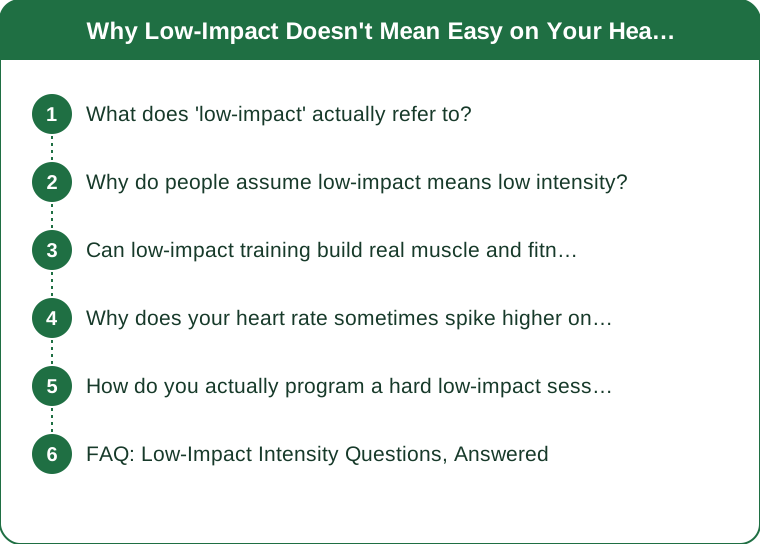
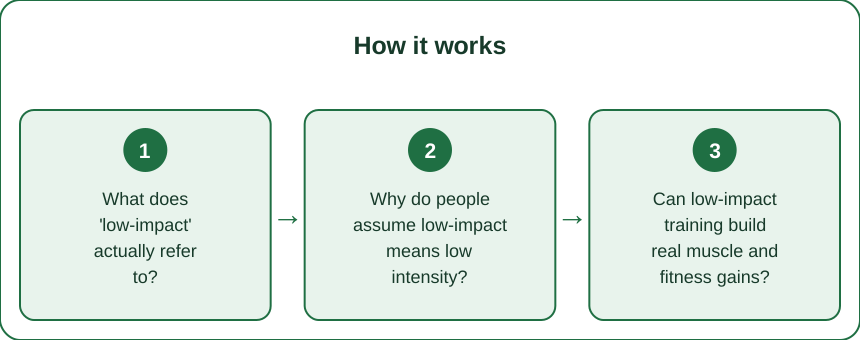
What does ‘low-impact’ actually refer to?
It refers specifically to ground-reaction force — how hard your joints absorb impact when a foot (or body part) contacts a surface. Running generates roughly 2-3 times bodyweight in impact force per step; cycling, swimming, and rowing generate close to zero.
Q: So intensity isn’t part of the definition at all? Correct — intensity is a separate variable entirely, controlled by resistance, speed, and duration, independent of impact level.
Why do people assume low-impact means low intensity?
Because early low-impact workouts marketed to beginners and rehab populations were often also low-intensity, the two got bundled together in popular understanding. But a hard 45-minute cycling interval session or a heavy rowing workout is both low-impact and high-intensity simultaneously.
Q: Can heart rate actually match a run in a low-impact session? Yes — well-programmed rowing or cycling intervals regularly push heart rate into the same zones as running intervals.
Can low-impact training build real muscle and fitness gains?
Yes, when intensity is deliberately programmed rather than assumed to be automatically gentle. Progressive resistance on a bike, increasing rowing pace, or adding load to step-ups all apply the overload principle that drives adaptation — impact level doesn’t determine whether overload is happening.
Q: Is there a downside to always choosing low-impact? Bone density benefits specifically require some impact loading, so a 100% low-impact routine long-term may want occasional weight-bearing impact work added back in for bone health, if joints allow.

Why does your heart rate sometimes spike higher on low-impact days?
Some low-impact modalities (rowing especially) engage more total muscle mass simultaneously than running does, which can drive heart rate up faster for a given perceived effort. This surprises people who assumed ‘gentler on joints’ would also mean ‘gentler on the heart’ — it often isn’t.
Q: Should that higher heart rate worry me? Not inherently — it reflects more muscle recruitment, not necessarily more strain, but pay attention to how you feel, not just the number.
How do you actually program a hard low-impact session?
Use interval structure just like you would running: alternate 30-60 second hard efforts with equal rest on a bike, rower, or elliptical, at a resistance/pace that makes the hard intervals genuinely difficult. Track heart rate or perceived exertion rather than assuming intensity is automatically capped by the modality.
FAQ: Low-Impact Intensity Questions, Answered
Can low-impact cardio really replace HIIT?
Yes, when structured as true intervals with hard effort and real recovery — the impact level doesn’t limit whether it qualifies as HIIT.
Is swimming considered low-impact or something different?
Swimming is essentially zero-impact due to water buoyancy, an even gentler category than low-impact land modalities like cycling.
Why do my knees hurt more on high-impact days, not rest days?
Cumulative impact loading (running, jumping) creates soreness that often peaks a day or two after the session, not immediately — a classic delayed pattern distinct from rest-day soreness.
TL;DR:
- Low-impact refers to joint stress, not cardiovascular difficulty — they’re separate variables
- Rowing and cycling intervals can match or exceed running’s heart rate demand
- Progressive overload still applies — low-impact isn’t automatically low-effort
- Mix in some impact work occasionally for bone density if your joints tolerate it
This is general fitness information, not medical advice — check with a doctor if you have joint conditions before increasing intensity.
Keep Reading
This article is for general informational purposes only and is not medical advice. Always consult a qualified health professional for guidance specific to you.