Why 'Low-Impact' Doesn't Mean Easy on Your Heart Rate (and How to Actually Gauge Intensity)
Quick Answer: Low-impact simply means reduced joint stress from landing forces, not reduced cardiovascular demand — a well-structured low-impact session (cycling, incline walking, rowing) can push heart rate into the same zones as high-impact training, the difference is entirely in how the intensity is generated.
What is a good heart rate for low-impact exercise? Aim for 50-85% of your max heart rate depending on your goal — low-impact doesn’t cap how high you can safely push it.
No jumping usually gets mentally filed under “easy.” A heart rate monitor tells a very different story once the resistance or incline actually gets dialed in.

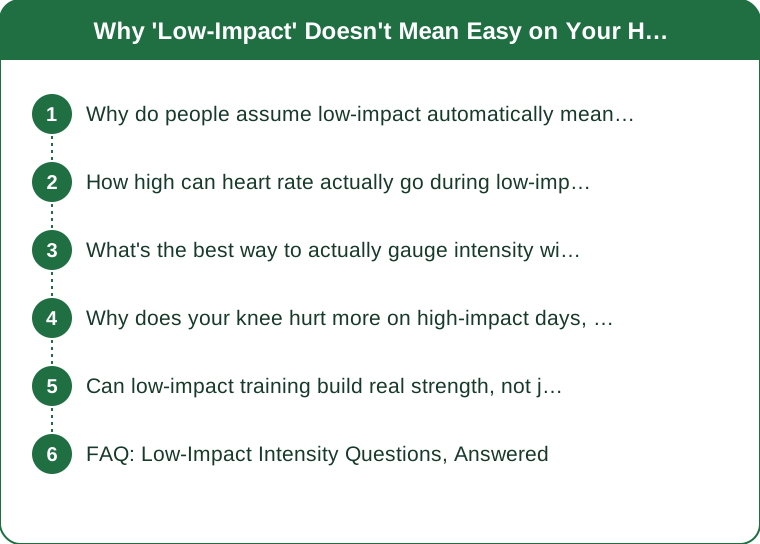
Why do people assume low-impact automatically means low-intensity?
“Impact” specifically refers to the force of landing on a joint, not the cardiovascular or muscular demand of the movement itself — the two get conflated because high-impact activities like running also happen to be intense by default, creating a false association.
Low-impact modalities like cycling, rowing, and swimming are used at the highest levels of competitive endurance sport, which alone should signal that the category has plenty of headroom for real intensity.
How high can heart rate actually go during low-impact training?
Well-structured low-impact interval training (incline walking intervals, rowing sprints, cycling sprints) can push heart rate into zone 4-5, the same ranges associated with high-intensity running intervals, given sufficient resistance or incline.
The limiting factor becomes leg and cardiovascular fatigue, not joint impact, meaning the ceiling on intensity is set by fitness level and effort, not by the low-impact nature of the movement.
What’s the best way to actually gauge intensity without impact as a cue?
Heart rate zones or a simple perceived exertion scale (1-10) work as reliable intensity indicators regardless of impact level, and are more accurate than judging effort by how “hard” the movement feels mechanically.
The talk test — being able to speak in short sentences but not hold a full conversation — is a practical zone-3 to zone-4 proxy that works without any equipment, useful for low-impact sessions specifically since breathlessness can be a subtler cue than in running.

Why does your knee hurt more on high-impact days, not rest days?
Repetitive landing forces from running or jumping accumulate joint stress across a session, which is exactly the mechanism low-impact training avoids while still allowing high cardiovascular output — this is the actual mechanical distinction, separate from intensity entirely.
Someone with joint sensitivity can still build serious fitness through low-impact intervals, since the cardiovascular and muscular systems don’t require joint-jarring forces to be meaningfully challenged.
Can low-impact training build real strength, not just cardio fitness?
Resistance-based low-impact training — weighted step-ups on a platform, low-impact strength circuits, resistance band work — builds genuine strength without relying on jumping or running mechanics.
Progressive overload principles apply identically to low-impact strength work, meaning gradually increasing resistance or reps drives adaptation the same way it does in higher-impact strength training.
FAQ: Low-Impact Intensity Questions, Answered
Is a low-impact HIIT workout a contradiction in terms?
No — HIIT refers to the interval structure (alternating high and low effort), which applies just as well to cycling or rowing intervals as to jumping-based intervals.
Should beginners start with low-impact even if joints aren’t currently a concern?
It’s a reasonable starting point regardless, since it allows building cardiovascular capacity while movement patterns and technique are still developing.
Does low-impact training burn fewer calories than high-impact?
Not necessarily — calorie burn tracks more closely with intensity and duration than with impact level, so a hard low-impact session can burn comparably to a moderate high-impact one.
TL;DR:
- Impact refers to joint landing force, not cardiovascular or muscular demand
- Low-impact intervals can push heart rate into the same zones as high-impact training
- Heart rate zones or the talk test gauge intensity more reliably than how “hard” a movement feels
- Resistance-based low-impact work builds real strength through the same overload principles
Low-impact protects the joints, not the intensity ceiling — the two variables are simply unrelated.
Keep Reading
This article is for general informational purposes only and is not medical advice. Always consult a qualified health professional for guidance specific to you.