Why Low Impact Does Not Mean Low Intensity
Quick Answer: Impact and intensity are independent dials. Impact describes the collision forces your joints absorb - jumping is high, cycling is near zero. Intensity describes how hard your cardiovascular system and muscles are working - and you can push it to genuinely brutal levels at zero impact: hill sprints on a bike, rowing intervals, incline treadmill climbs, swimming repeats, sled pushes. The confusion costs people results in both directions - some avoid effective training because they think joint-friendly means easy, others train low-impact permanently at strolling effort and wonder why nothing changes. Keep the impact low and the effort honest, and the adaptations match high-impact training where it counts.
Gentle on the joints and gentle on you are two different promises. The first one is real. The second one was never made.

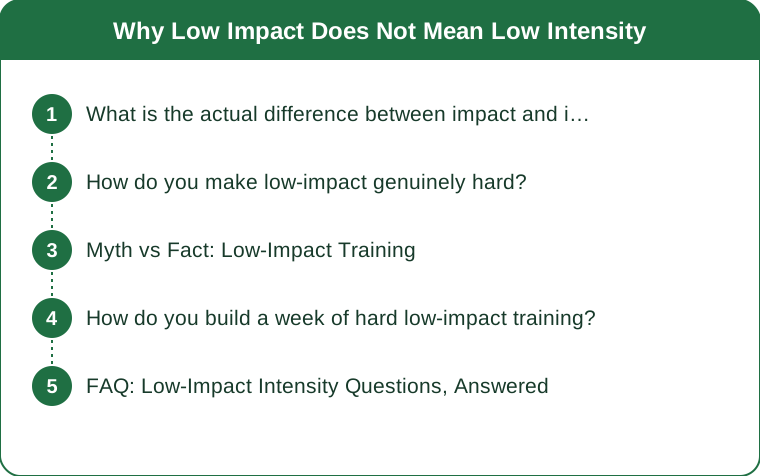
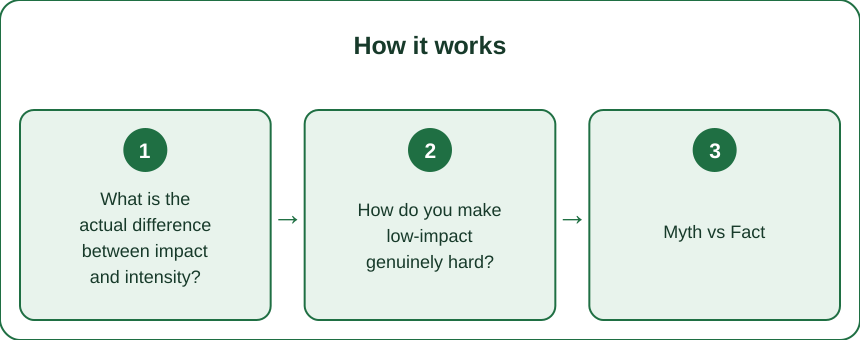
What is the actual difference between impact and intensity?
Two separate axes that the fitness world keeps collapsing into one.
Impact is collision. It is the jolt transmitted through your skeleton when your body meets a surface - landing from a jump, footstrike on a run. High-impact moves load joints with multiples of body weight in milliseconds; low-impact moves keep at least one point of contact and shrink those spikes dramatically; no-impact modalities like cycling, rowing, and swimming remove them almost entirely.
Intensity is output. Heart rate, breathing, muscular effort, the rate you are burning fuel - how hard the engine is running, regardless of what the chassis is absorbing. Intensity is what drives cardiovascular adaptation, and your heart genuinely cannot tell what modality is producing it.
Every combination exists. High-impact low-intensity: lazy rope skipping. Low-impact low-intensity: a stroll. High-impact high-intensity: sprint hurdles. And the quadrant everyone forgets - low-impact high-intensity: a rowing interval that ends conversation for two minutes, a bike hill repeat, an incline treadmill climb at a pace you can barely hold.
Joints care about the first axis; hearts care about the second. That is the entire logic of training low-impact hard: you route the stimulus to the systems you want to train while un-loading the tissues that need protecting.
The label misleads in both directions. Low-impact classes get skipped by people chasing a real workout, and get coasted through by people who assume showing up was the workout. Both groups are reading one dial and missing the other.
How do you make low-impact genuinely hard?
The tools are resistance, incline, speed, and rest design - the same levers as any training.
Intervals are the master key. Alternate hard pushes with easy recovery on any zero-impact machine: 30 seconds strong, 90 seconds easy on a bike; 250-meter rowing repeats; fast-slow lap alternation in a pool. Intervals let you visit intensities that steady effort cannot sustain - which is exactly where the underestimated adaptations live.
Incline turns walking into climbing. A treadmill at 10 to 15 percent grade walked at moderate speed produces running-level heart rates at walking-level impact - the reason incline-walk workouts earned their popularity honestly. Outdoors, hills and stairs-machine sessions do the same job.
Resistance turns cycling into strength-cardio. High-resistance seated climbs on a spin bike demand real leg force per stroke - closer to weighted squatting rhythms than to easy pedaling, at zero collision.
Water rewards effort with resistance that scales. Water is thick: move faster and it pushes back harder, automatically matching your intensity while unloading your entire skeleton. Hard swim or aqua intervals are elite conditioning with the gentlest joint bill in fitness.
Strength work counts too. Sled pushes, kettlebell swings kept smooth, step-ups, and controlled circuit lifting all raise heart rate substantially - low-impact conditioning disguised as strength training.
Calibrate by talk test, not by modality. Hard means phrases, not paragraphs; the last thirty seconds of an interval should make conversation unwelcome. If you can narrate your day comfortably, the impact is low and so - unhelpfully - is the intensity.
And dress for output, not for the stroll the label implies - sweat-wicking layers and high-waisted leggings that stay anchored through a sled push, because a real session is coming.

Myth vs Fact: Low-Impact Training
Myth: Low impact is for beginners and recovery days only. Fact: It is also how competitive cyclists, rowers, and swimmers - some of the fittest athletes alive - do nearly all their training. The modality ceiling is elite; only the collision is missing.
Myth: You cannot get a real cardio adaptation without impact. Fact: Cardiovascular adaptation follows intensity and volume, not collision. Matched for effort, bike and rowing intervals produce comparable heart-lung improvements to running intervals - your cardiovascular system reads workload, not footstrikes.
Myth: Low-impact burns dramatically fewer calories. Fact: Calorie burn tracks intensity and duration. An easy stroll burns little; a hard rowing or incline session burns on par with running the same effort and time. The gap people observe is usually an effort gap wearing a modality costume.
Myth: If your joints feel fine, you should graduate back to high impact. Fact: Impact tolerance is worth maintaining for bone density and for life’s unavoidable jolts - but high impact is a seasoning, not a requirement. Many people run their entire cardiovascular life low-impact and keep bones honest with strength training and modest impact doses like brisk hill walking.
Myth: Low-impact means low skill. Fact: Rowing technique, swim stroke, and pacing strategy are genuine skills that gate how much intensity you can access. The learning curve is part of why people under-dose these modalities - bad technique caps effort before the heart ever gets asked.
Myth: Soreness proves high impact works better. Fact: Soreness tracks novelty and eccentric load, not effectiveness. A first hard rowing session will settle that argument personally.
How do you build a week of hard low-impact training?
A template that trains every system while the joints stay on payroll.
Two interval days - the intensity anchors. Pick your machine: bike, rower, elliptical, pool. Warm up ten minutes, then 6 to 8 rounds of 1 minute hard, 2 minutes easy - hard meaning the talk test fails by the end. These two sessions carry the cardiovascular progress for the week.
One long steady day - the volume base. Forty-five to seventy-five minutes of incline walking, easy cycling, or swimming at conversational effort. This is the low-intensity day, and it is supposed to be - the mistake is making every day this day.
Two strength days. Squat, hinge, push, pull, carry - controlled tempos, real loads. Strength training is itself low-impact, protects bone density, and raises the ceiling on what your interval days can produce.
Progress one variable weekly. Add a round, shave rest, raise resistance or incline - small, logged, relentless. Low-impact training stalls for the same reason any training stalls: the dose stopped growing, not because the modality ran out.
Keep one honest metric. Time for a fixed rowing distance, average watts for a set interval block, floors climbed at a set heart rate - re-tested monthly. Low-impact progress hides without a number; with one, it is unmistakable.
Respect the recovery it still demands. Zero collision does not mean zero fatigue - hard intervals tax the same recovery budget as any training. Sleep, protein, and the easy day between anchors are what let next week’s dose grow.
And keep gear friction at zero: supportive shoes for incline work, a towel for the rower, buttery-soft leggings that survive both the bike saddle and the squat rack - small comforts that keep the hard sessions repeatable, which is the entire game.
FAQ: Low-Impact Intensity Questions, Answered
Can low-impact workouts really be as effective as running?
For cardiovascular fitness and calorie burn, yes - matched for intensity and time, bike, rowing, swimming, and incline sessions produce comparable adaptations. What running uniquely adds is impact-specific bone loading and sport-specific gait fitness; strength work and modest impact doses cover most of that gap.
How do I know if my low-impact workout is intense enough?
Use the talk test: moderate effort allows sentences but not songs; hard intervals should end conversation in the final stretch. Heart rate in your usual hard-session zones confirms it - the modality does not change the zones.
What is the hardest low-impact cardio?
Rowing intervals, high-resistance bike climbs, steep incline treadmill walks, swim repeats, and sled pushes top most lists - all capable of elite-level demand at near-zero collision. The limiting factor is usually technique and pacing skill, not the machine.
Is walking enough, or do I need more?
Walking is a superb base and health floor; for continued fitness gains most people need an intensity element on top - which incline, hills, or interval pacing can add without any impact increase. Same walk, harder dial.
Do I ever need high-impact exercise?
Bones respond best to some impact and to heavy strength work, so modest doses - brisk hill walking, light hops if tolerated, or simply lifting - are worth keeping unless a condition rules them out. For heart, lungs, muscle, and fat loss, low-impact done hard covers the whole brief.
TL;DR:
- Impact is joint collision; intensity is engine output - independent dials, endlessly confused.
- Zero-impact modalities reach elite intensity: rowing and bike intervals, incline climbs, swim repeats, sleds.
- Calibrate by talk test and heart rate - the modality never changes the zones.
- Build the week: two interval anchors, one long steady day, two strength days, one progressing variable.
- Keep a monthly number so the progress is visible and the dose keeps growing.
Low impact is a promise to your joints, not a ceiling on your effort. Keep the collisions low, keep the honesty high, and the results stop caring which machine you chose.
See It in Motion
Seen here: High Waist Yoga Leggings with Side Pockets — shop it on bubblelime.com
Keep Reading
This article is for general informational purposes only and is not medical advice. Always consult a qualified health professional for guidance specific to you.