Low Impact Training in Heat, Every Question Answered
Quick Answer: Heat affects low-impact training more than people expect, because heart rate rises 5 to 15 beats at the same workload and effort perception climbs with it. Indoor cycling and rowing are the hardest low-impact options in heat because they generate substantial internal heat with limited airflow. Swimming is the easiest, and outdoor walking sits in between and depends entirely on shade and humidity. Adjust by effort rather than by pace or watts, and expect to need two to three weeks to acclimatise.
The same 40 minute bike session you did comfortably in May now leaves you with a heart rate 12 beats higher and a genuine question about whether you should stop.

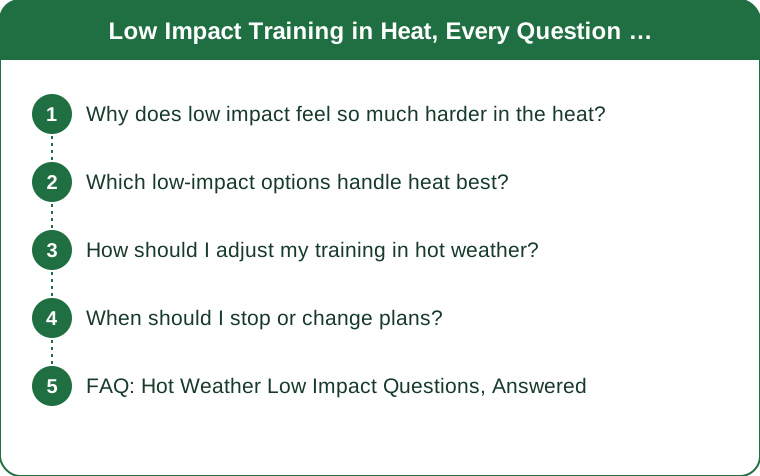
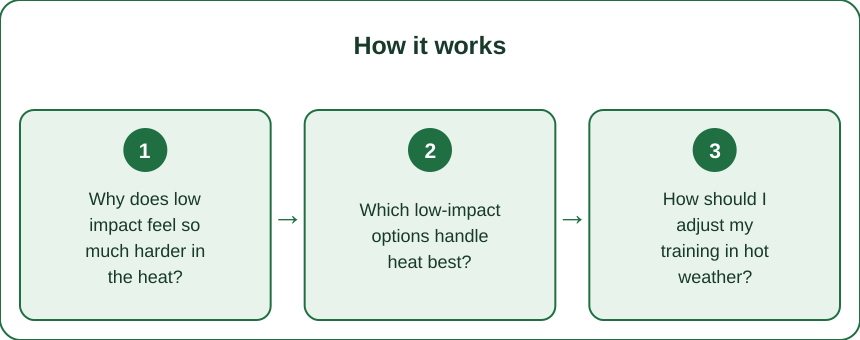
Why does low impact feel so much harder in the heat?
The joints are unaffected. Your cardiovascular system is not.
Blood is diverted to the skin for cooling. That blood is no longer available to working muscle, so the heart compensates by beating faster - typically 5 to 15 beats per minute higher at the same workload. This is called cardiac drift and it is entirely normal.
Sweating reduces blood volume. Less plasma means less blood returning to the heart per beat, so the rate rises further. This effect grows across a session as fluid loss accumulates.
Humidity blocks the cooling mechanism. Sweat only cools you when it evaporates. In humid air, it runs off without doing its job, so you lose fluid without gaining cooling - the worst of both.
Perceived effort rises independently of the physiology. The same session genuinely feels harder in heat even accounting for heart rate, which is why pacing by feel goes wrong in summer.
Low impact does not mean low heat production. Metabolic heat is produced by working muscle regardless of whether your feet strike the ground. A hard cycling session generates as much internal heat as a run at the same effort.
And indoor is frequently worse than outdoor. A stationary bike in a warm room has almost no airflow, whereas moving outdoors generates its own breeze. This is the most commonly missed factor.
Which low-impact options handle heat best?
There is a clear ranking, and it surprises most people.
Swimming is the easiest by a wide margin
Water conducts heat away from the body far more efficiently than air, so core temperature stays controlled at effort levels that would be difficult on land. The caveat is that you sweat without noticing and dehydration creeps up unseen.
Outdoor walking is manageable with shade
Self-generated airflow plus moderate intensity makes walking the most sustainable outdoor option. In direct sun at midday it becomes considerably harder, and the difference between a shaded route and an exposed one is larger than the difference between walking and jogging.
The elliptical is middling
Moderate heat generation, no impact, and entirely dependent on the room. In an air-conditioned gym it is comfortable; in a warm home room without a fan it is one of the harder options.
Indoor cycling is the hardest
High power output, high heat generation, and no airflow at all unless you provide it. This is the low-impact modality most likely to produce genuine heat problems, and a fan changes it more than any other adjustment.
Rowing is close behind cycling
Large muscle mass involvement means high heat production, and rowing indoors has the same airflow problem. It is also the modality where people most commonly push through discomfort they should respect.
The general rule: airflow matters more than modality. A fan pointed at you transforms indoor cycling; its absence makes any indoor session substantially harder.

How should I adjust my training in hot weather?
The adjustments are simple and most people make none of them.
Train by effort, not by numbers
Your usual watts, pace, or resistance level represents a harder effort in heat. Holding the number means training harder than intended, every session, for a whole season.
Expect heart rate to be 5 to 15 beats higher
If you train by heart rate zones, this is not a fitness loss. Either accept the higher numbers at lower workloads, or switch to effort-based training for the summer.
Shorten before you soften
A 30 minute session at proper intensity beats a 50 minute one you have to drag yourself through. Cutting duration preserves quality better than reducing intensity.
Move the session to the coolest part of the day
Early morning is meaningfully cooler and less humid than evening in most climates, and it is the single most effective change available for outdoor work.
Add airflow indoors
A decent fan is the highest-value equipment purchase for summer indoor training. It changes effective temperature substantially and costs less than a month of gym membership.
Hydrate before, during, and after
Roughly 500ml in the two hours before, 150 to 250ml every 15 to 20 minutes during, and enough afterwards to return urine to pale straw. Add electrolytes for sessions over an hour or in high humidity.
And expect acclimatisation to take two to three weeks. Plasma volume increases, sweating starts earlier and at a higher rate, and the same session becomes genuinely easier. This is why late August often feels better than early July at the same temperature.
When should I stop or change plans?
Some signals are worth respecting immediately.
Stop for these
Dizziness, nausea, headache during exercise, confusion, or stopping sweating while still hot. That last one is particularly important - skin that becomes dry and hot during exertion in heat is a medical emergency and needs immediate cooling and help.
Reduce intensity for these
Heart rate 15 or more beats above normal for the workload, effort that feels disproportionate to the numbers, or unusual heaviness in the legs early in a session.
Move indoors or reschedule for these
High humidity combined with high temperature, direct midday sun with no shade available, or poor air quality, which frequently accompanies heatwaves.
Be more cautious if any of these apply
Pregnancy, cardiovascular conditions, medications affecting fluid balance or heat regulation, being new to exercise, or being unacclimatised after time indoors.
Recognise that heat illness progresses. Heat exhaustion - heavy sweating, weakness, nausea, cool clammy skin - is the warning stage and responds to cooling, fluids, and rest. Heat stroke, with confusion and hot dry skin, is an emergency.
And treat a bad session in heat as information, not weakness. People routinely push through in summer sessions in a way they would not in any other conditions, and it is the most common route to a genuinely bad outcome.
This is general information, not medical advice. Seek medical guidance about exercising in heat if you have any relevant health condition or take regular medication.
FAQ: Hot Weather Low Impact Questions, Answered
Why is my heart rate so much higher in hot weather?
Blood is diverted to the skin for cooling and sweating reduces blood volume, so the heart beats faster to deliver the same oxygen. An increase of 5 to 15 beats at the same workload is normal and not a fitness loss.
Is swimming the best exercise in hot weather?
For heat management, yes - water conducts heat away far more effectively than air. The main risk is that you dehydrate without noticing, so drink as you would for a land session.
Why is indoor cycling harder in summer than running outside?
Because there is no airflow. Moving outdoors generates its own breeze that carries heat away, while a stationary bike in a warm room has none. A fan closes most of that gap.
How long does it take to get used to exercising in heat?
Two to three weeks of regular exposure. Plasma volume increases and sweating begins earlier and more efficiently, which is why the same temperature feels considerably easier by late summer.
Should I still train if it is very hot and humid?
Yes, with adjustments - shorter, earlier, indoors with a fan, or in water. The combination of high heat and high humidity is the condition most worth rescheduling for, since evaporation stops working.
What are the warning signs I should stop?
Dizziness, nausea, headache during exercise, confusion, or skin that stops sweating and becomes hot and dry. The last one is a medical emergency requiring immediate cooling and help.
TL;DR:
- Heat raises heart rate 5 to 15 beats at the same workload - that is cardiac drift, not lost fitness.
- Swimming handles heat best, outdoor walking is manageable with shade, indoor cycling and rowing are hardest.
- Airflow matters more than modality; a fan is the best summer training purchase you can make.
- Train by effort rather than pace or watts, shorten before softening, and move sessions to early morning.
- Dizziness, confusion, or stopping sweating while hot means stop immediately and get help.
Low impact protects your joints. It does nothing at all for your thermoregulation, and August is the month that difference shows up.
Keep Reading
This article is for general informational purposes only and is not medical advice. Always consult a qualified health professional for guidance specific to you.