Low-Impact Cardio Questions People Usually Only Ask Mid-Workout
Quick Answer: Low-impact cardio builds real cardiovascular fitness and can build meaningful strength when intensity and resistance are managed deliberately — the ‘low impact’ label refers to joint stress, not to workout intensity, which is a distinction most people don’t realize mid-session while wondering if they’re working hard enough.
Somewhere around minute 15 on the elliptical or the bike, the same question always surfaces: is this actually doing anything? Here are the honest answers to what people usually only wonder mid-workout.

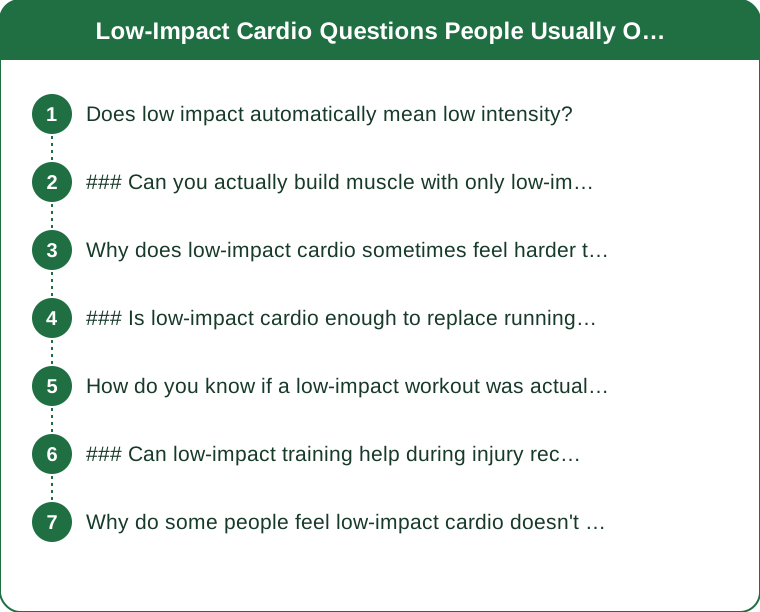
Does low impact automatically mean low intensity?
No — this is the most common mid-workout doubt, and it’s based on a real mix-up. ‘Low impact’ describes joint stress (no ground-pounding force), not effort level. A hard interval session on a bike or elliptical can hit the same heart rate zones as a hard run; the difference is purely in how much force travels through the joints.
### Can you actually build muscle with only low-impact training?
Yes, with proper resistance — low-impact strength training (using bands, machines, or controlled bodyweight work) builds muscle through the same progressive overload principle as any other strength approach; the impact profile has no bearing on the muscle-building mechanism itself.
Why does low-impact cardio sometimes feel harder than expected on heart rate?
Certain low-impact modes, particularly cycling and swimming, can actually elevate heart rate more than running at a similar perceived effort for some people, since the muscles working (often smaller muscle groups in cycling) fatigue and demand oxygen differently than the larger muscle groups engaged in running.

### Is low-impact cardio enough to replace running entirely?
For most fitness and health goals, yes — cardiovascular adaptations respond to sustained effort and heart rate zones, not to the specific impact profile of the activity producing them. Running-specific performance goals (like race training) are the main exception where sport-specific impact training still matters.
How do you know if a low-impact workout was actually hard enough?
Track heart rate zones or use a perceived exertion scale rather than judging by how much impact or sweat you felt — a properly hard low-impact session should still land you in the same target heart rate zones a harder-feeling high-impact workout would.
### Can low-impact training help during injury recovery without slowing progress?
Often yes, when cleared by a physical therapist or doctor — many low-impact modalities let cardiovascular fitness continue building while an injury heals, which is a genuine advantage over stopping cardio entirely during recovery.
Why do some people feel low-impact cardio doesn’t ‘count’ as a real workout?
This is largely a perception gap tied to less visible sweat and lower joint-impact sensation, not an accurate reflection of the actual cardiovascular work being done — heart rate data consistently shows a well-executed low-impact session working the cardiovascular system just as effectively as its higher-impact equivalent.
TL;DR:
- ‘Low impact’ refers to joint stress, not workout intensity — the two are independent variables
- Muscle can be built through low-impact resistance work via the same progressive overload principle as any training style
- Some low-impact modes (cycling, swimming) can elevate heart rate more than running at similar perceived effort
- Track heart rate zones, not sweat or impact feel, to judge whether a low-impact session was actually hard enough
Next elliptical session, check your heart rate zone instead of second-guessing the workout — that number settles the ‘is this doing anything’ question directly.
Keep Reading
This article is for general informational purposes only and is not medical advice. Always consult a qualified health professional for guidance specific to you.