Low Impact Cardio: Every Question You Have, Answered
Quick Answer: Low impact means one foot stays in contact with a surface, not that the effort is low. Done at the right intensity it builds the same cardiovascular adaptations as running — the limiting factor is that most people do it too easily. The honest comparison: low impact requires more time or more deliberate intensity to match running’s cardiovascular stimulus, and it substantially reduces joint loading while doing it.
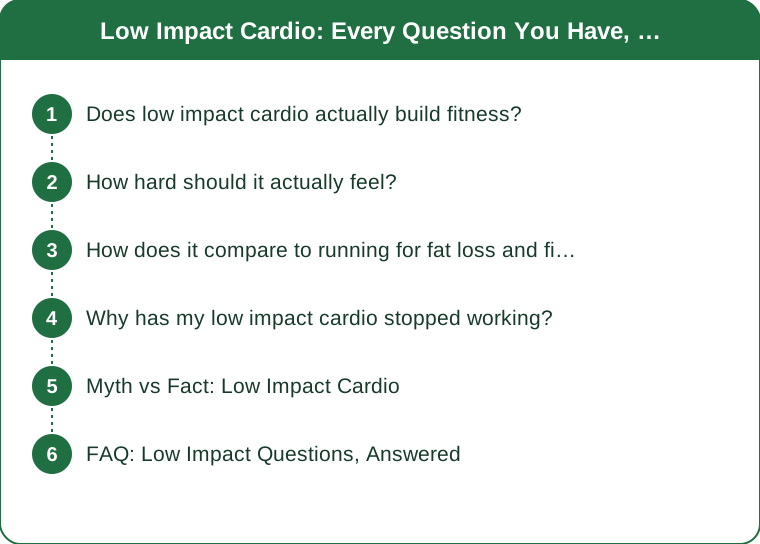
Every question people actually ask about low impact cardio, answered in order.

Does low impact cardio actually build fitness?
Yes, and the mechanism is identical. The catch is intensity, not modality.
Cardiovascular adaptation responds to intensity and duration, not impact. Stroke volume, capillary density, mitochondrial adaptation and lactate threshold all improve in response to the demand placed on the system, regardless of whether your feet leave the ground.
Elliptical, cycling, rowing and swimming all produce genuine aerobic improvement. This is well established and not controversial.
The problem is that low impact feels easier at the same heart rate. Without impact, perceived exertion tends to be lower for a given cardiovascular load, so people self-select an easier effort and get less from the session.
Weight-bearing benefits do differ. Running and walking load bone in ways cycling and swimming do not. For bone density specifically, some weight-bearing activity matters.
Muscle recruitment patterns differ too. Rowing loads the back and arms heavily; cycling loads the quads; the elliptical distributes broadly. None of them replicate running’s eccentric demand on the calves and hamstrings.
The verdict: for cardiovascular fitness, low impact is fully capable. For bone loading and running-specific tissue tolerance, it is not a complete substitute.
How hard should it actually feel?
Harder than most people do it. Here is the calibration.
For steady aerobic work, aim for Zone 2. Roughly 60 to 70 percent of maximum heart rate, or the effort where you can hold a conversation in full sentences but would rather not.
The talk test is the practical version. Comfortable sentences means Zone 2. Short phrases means Zone 3 or above. Single words means you are near threshold.
If you can read your phone comfortably, it is too easy. This is the honest test for elliptical and bike sessions in a gym.
Include some genuinely hard work. One or two sessions a week with intervals at an effort you cannot sustain for more than a few minutes produces adaptations that steady work does not.
Use resistance rather than speed on machines. Spinning the elliptical fast at no resistance produces movement without much cardiovascular demand. Increase resistance and slow the cadence.
Duration should be longer than for running. Because the eccentric and impact demand is lower, matching a 30-minute run’s total stimulus often takes 40 to 50 minutes of easy low-impact work.
Monitor heart rate if you can. Perceived exertion is unreliable in low-impact modalities specifically, which is where a monitor earns its keep.
How does it compare to running for fat loss and fitness?
Closer than most people assume, with one honest caveat about time.
Energy expenditure is what drives fat loss, and it is intensity-dependent. A hard 45 minutes on a rower can match or exceed a moderate 30-minute run. An easy 45 minutes on an elliptical will not.
Running is more time-efficient. For a given amount of energy expended, running usually takes less time. If time is your constraint, that matters.
Low impact allows more total volume. Because recovery cost is lower, many people can do considerably more weekly volume without accumulating the tissue stress running produces. Over a month that can more than compensate.
Joint loading is substantially lower. Ground reaction forces in running are several times body weight. Cycling and swimming are a fraction of that, and the elliptical sits in between.
It is better for consistency in some populations. For people with joint pain, higher body weight, or returning from injury, low impact is the option that gets done — and the option that gets done beats the theoretically superior one that does not.
Rowing is the most complete option. It combines high cardiovascular demand with substantial muscular involvement and remains low impact, which is why it is disproportionately recommended.
Swimming is the lowest impact and the hardest to self-regulate. Technique limits effort for most people more than fitness does.

Why has my low impact cardio stopped working?
Almost always because the stimulus stopped increasing while the sessions stayed the same.
Your body adapted to the exact workload. Thirty minutes at the same resistance produces adaptation for a few weeks and then maintenance. Maintenance is not progress.
Efficiency works against you. As you get better at the movement, you burn less energy doing the same thing. This is real and it is measurable on machines.
Machine calorie readouts are optimistic. They routinely overestimate, often substantially, and they do not adjust for your improving efficiency.
Progressive overload applies to cardio too. Increase duration, resistance, or intensity — one at a time, roughly every two to three weeks.
Add intervals if everything is steady state. Even one session a week of hard intervals restarts adaptation in most people who have plateaued.
Vary the modality. Switching between rowing, cycling and elliptical recruits different muscle groups and interrupts the efficiency adaptation.
Check that you are not compensating elsewhere. Increased exercise often produces reduced spontaneous daily movement and increased appetite. Both are normal and both blunt results.
Add resistance training. If the goal is body composition, cardio alone plateaus much sooner than cardio plus lifting.
Seasonal note: as outdoor activity drops through autumn, total daily movement falls even when gym sessions stay constant. If your results changed and your training did not, this is usually why.
Myth vs Fact: Low Impact Cardio
Myth: Low impact means low intensity. Fact: It describes the mechanics, not the effort. A hard rowing session is low impact and brutally intense.
Myth: It is only for older people or injuries. Fact: Competitive athletes across many sports use it extensively for volume without tissue cost.
Myth: The elliptical does nothing. Fact: It does very little at low resistance with the handles doing the work. Used properly with real resistance, it is an effective cardiovascular tool.
Myth: Swimming is the best cardio for everyone. Fact: It is excellent, but technique limits intensity for most recreational swimmers, and it provides no weight-bearing bone stimulus.
Myth: You need impact for bone health. Fact: You need loading. Impact is one form; heavy resistance training is another and works well.
FAQ: Low Impact Questions, Answered
How many minutes a week should I do?
Common public health guidance is 150 minutes of moderate or 75 minutes of vigorous activity weekly. For low impact, lean toward the higher end of moderate.
Is walking enough?
Brisk walking counts and is genuinely beneficial. Whether it is enough depends on your goals and your starting point — for many people it is a floor rather than a ceiling.
Can I do it every day?
Yes, at easy intensity. Hard sessions still need recovery regardless of impact.
Which machine is best?
Rowing for total-body demand, cycling for sustained high-intensity work, elliptical for the closest thing to running mechanics without the impact.
Does it help knee pain?
Often yes, both by reducing loading and by strengthening the surrounding musculature. Persistent joint pain deserves assessment rather than self-management. This is general information, not medical advice.
Should I still lift weights?
Yes. Cardio and resistance training produce different adaptations, and for body composition and long-term health the combination substantially outperforms either alone.
TL;DR:
- Low impact describes mechanics, not effort. The usual failure is intensity, not modality.
- Cardiovascular adaptation is the same — but bone loading and running-specific tolerance are not.
- Use the talk test: comfortable sentences is Zone 2, phone-reading is too easy.
- Apply progressive overload — increase resistance, duration or intensity every two to three weeks.
- Rowing is the most complete low-impact option.
Raise the resistance and slow the cadence on your next session. Same time, different result.
Keep Reading
This article is for general informational purposes only and is not medical advice. Always consult a qualified health professional for guidance specific to you.