Is Swimming Actually Considered Low-Impact, or Is It Its Own Category?
Quick Answer: Swimming is technically low-impact — water’s buoyancy removes nearly all of the joint-loading force that land-based exercise involves — but it also adds resistance in every direction of movement, which most other low-impact cardio (cycling, elliptical) doesn’t, making it a genuinely distinct category that offers both cardio and a light-to-moderate strength stimulus simultaneously.
Swimming technically checks the low-impact box, but grouping it with cycling and elliptical undersells what’s actually happening in the water.

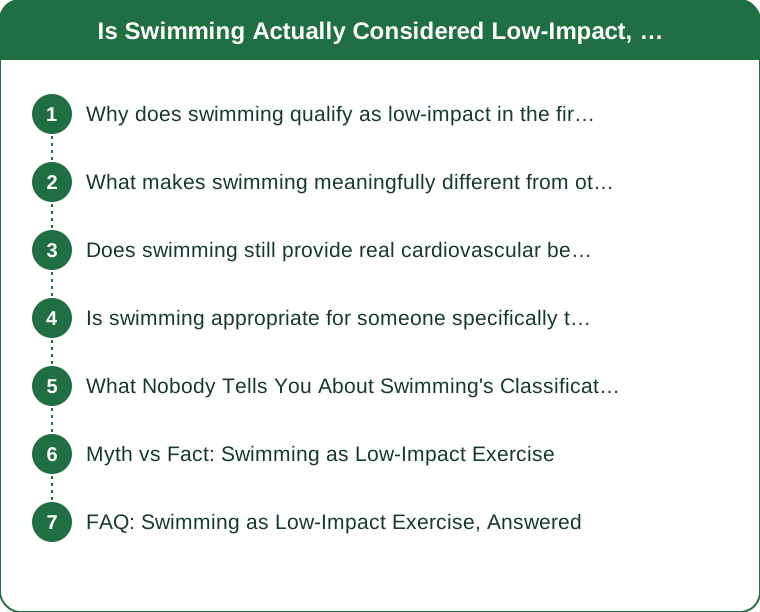
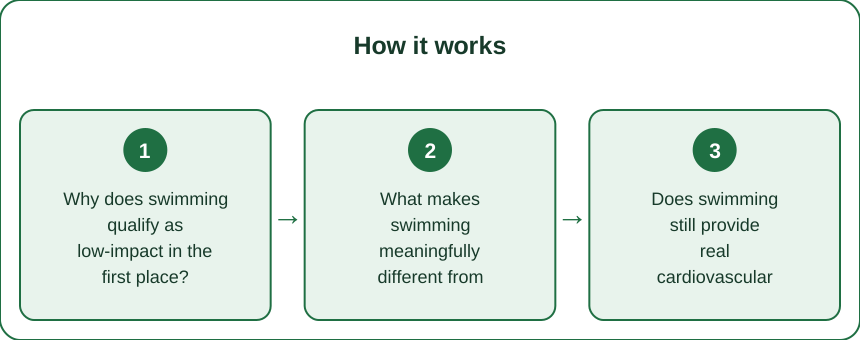
Why does swimming qualify as low-impact in the first place?
Water’s buoyancy supports a significant portion of body weight, dramatically reducing the gravitational loading force that joints normally absorb during land-based movement. This is why swimming is so commonly recommended during injury recovery or for people managing joint sensitivity — the water is doing a large share of the weight-bearing work that the joints would otherwise handle alone.
The degree of support depends on water depth and body position — someone standing chest-deep still bears meaningful weight through the legs, while a fully horizontal swimmer in deeper water experiences buoyancy support closer to its maximum effect, which is part of why swimming laps and standing water aerobics can feel like genuinely different categories of joint loading despite both happening in a pool. Water depth alone is a useful variable to adjust for anyone specifically trying to dial in how much joint loading they want in a given session, without needing to change the activity itself.
What makes swimming meaningfully different from other low-impact cardio like cycling or elliptical?
Unlike cycling or elliptical, which move primarily in a fixed, repetitive plane, swimming requires pushing against water resistance in multiple directions simultaneously with nearly every major muscle group engaged for propulsion. This gives swimming a resistance-training component that most other low-impact cardio options simply don’t include in the same way, blurring the usual line between cardio and strength work.
Water is roughly 800 times denser than air, and that density is what creates resistance in every direction of movement rather than just against gravity the way land-based cardio does. A swimming stroke engages the shoulders, back, core, and legs simultaneously to move through that resistance, which is a meaningfully different demand profile than pedaling a stationary bike, where the lower body does almost all of the work while the upper body stays largely uninvolved for the entire session. This full-body engagement is a big part of why a relatively short swim session can leave someone feeling more thoroughly worked than a much longer session on a stationary bike or elliptical machine.
Does swimming still provide real cardiovascular benefit despite the reduced joint loading?
Yes, substantially — the cardiovascular demand of swimming can be just as significant as running or cycling, particularly because the body has to work against water resistance across the whole stroke, and breath control adds its own respiratory training component that land-based cardio doesn’t replicate. Heart rate response during swimming is also affected by water temperature and horizontal body position, which is why the same effort level can feel and register differently than land-based cardio.
The horizontal body position specifically changes how the heart works compared to upright exercise — with less gravitational pull working against blood return to the heart, some research suggests heart rate at a given effort level can actually run somewhat lower during swimming than the equivalent perceived effort would produce on land, which is worth knowing for anyone using heart rate zones to guide swim training and expecting the exact same numbers to translate directly from a land-based cardio session.

Is swimming appropriate for someone specifically trying to build muscle, not just cardio fitness?
It can contribute meaningfully to muscular endurance and some strength gains, especially for beginners or those returning from injury, but it’s generally less effective than dedicated resistance training for building maximal strength or significant muscle mass, since water resistance scales with speed rather than allowing truly heavy, progressive overload the way weights do. Many people use swimming to complement, rather than replace, a separate strength training routine.
What Nobody Tells You About Swimming’s Classification
Swimming is sometimes left out of “low-impact” recommendation lists entirely, not because it doesn’t qualify, but because content default to cycling and elliptical as the more familiar gym-based options. This is largely a familiarity gap rather than a reflection of swimming being somehow less suited to the category — if anything, swimming offers a more complete package of reduced joint loading plus full-body engagement than either of the more commonly recommended alternatives, and deserves more attention in low-impact conversations than it typically gets.
Access is probably the more honest explanation for the gap — a stationary bike or elliptical is available in nearly every gym and many homes, while a proper pool requires a specific facility most people don’t have easy daily access to. That practical access barrier likely explains more of swimming’s lower profile in “low-impact cardio” content than any real difference in how well it actually fits the category.
Myth vs Fact: Swimming as Low-Impact Exercise
Myth: Swimming and cycling offer basically the same type of low-impact workout. Fact: Swimming’s multi-directional resistance and full-body engagement make it a meaningfully different stimulus than cycling’s single-plane, lower-body-dominant motion.
Myth: Low-impact automatically means low-intensity. Fact: Swimming can be pushed to a very high intensity level — competitive swimmers train at elite cardiovascular output — while still remaining gentle on the joints specifically.
Myth: Swimming isn’t a real workout unless it’s structured laps in a pool. Fact: Water aerobics, aqua jogging, and even structured treading-water intervals all carry the same core low-impact, water-resistance benefits as lap swimming, just in a different format.
FAQ: Swimming as Low-Impact Exercise, Answered
Is swimming a good option for someone recovering from a joint injury?
Often yes, and it’s frequently recommended in physical therapy and rehab settings specifically because of reduced joint loading, though clearance from a doctor or physical therapist is still important before starting, especially post-surgery.
Does swimming build the same kind of muscle definition as land-based strength training?
It can support lean muscle tone and endurance, but for significant strength or hypertrophy goals, dedicated resistance training with progressive overload remains more effective and reliable.
How does swimming compare to elliptical training for someone managing knee sensitivity?
Both are considered joint-friendly, but swimming generally offers even less joint loading than elliptical, since water removes essentially all body-weight impact rather than just reducing it. Stroke choice also matters within swimming itself — strokes like breaststroke put more rotational demand on the knees than freestyle or backstroke, so someone managing knee sensitivity specifically may want to favor freestyle or backstroke rather than assuming all strokes carry identical joint demand.
TL;DR:
- Swimming qualifies as low-impact because water buoyancy removes most joint-loading force
- Multi-directional water resistance gives it a strength component most low-impact cardio lacks
- Cardiovascular demand stays high despite the reduced joint impact
- It complements, rather than fully replaces, dedicated resistance training for muscle-building goals
Swimming earns its low-impact label honestly, but treating it as interchangeable with cycling or elliptical misses what actually makes it a genuinely distinct category of exercise.
Keep Reading
This article is for general informational purposes only and is not medical advice. Always consult a qualified health professional for guidance specific to you.