Is Low Impact Actually Enough to Build Real Fitness?
Quick Answer: For cardiovascular fitness: yes, completely — intensity determines the training effect, not impact. For strength and muscle: yes — resistance training is inherently low impact. For bone density: not fully, because bone responds specifically to impact and high loading. If you train exclusively low impact, add either heavy resistance work or a small deliberate dose of impact to cover that gap.
Low impact is not low intensity. Those get conflated constantly, and the confusion costs people a lot of unnecessary joint stress.

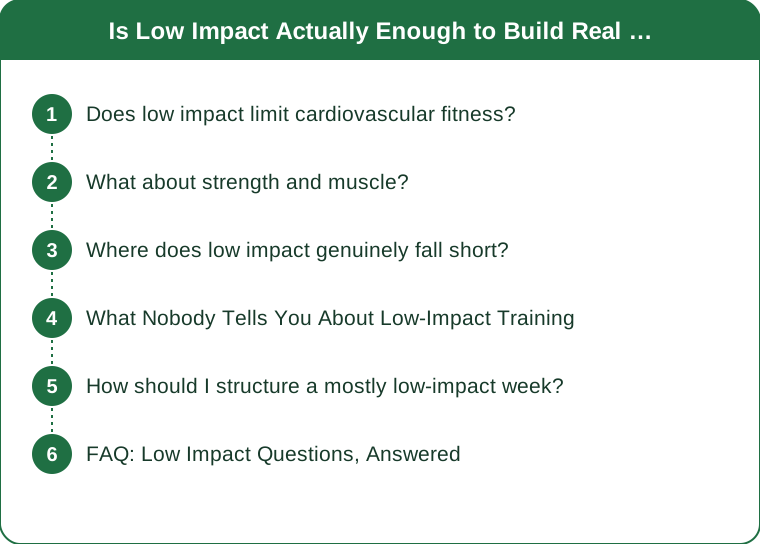
Does low impact limit cardiovascular fitness?
No. Not at all. Impact and intensity are unrelated variables.
Cardiovascular adaptation is driven by how hard your heart and lungs work, not by ground reaction forces. A rowing machine, an assault bike, or swimming can drive heart rate as high as any run.
Cycling, rowing, swimming, and elliptical work all produce genuine cardiovascular adaptation — this is not a compromise or a lesser version. Competitive cyclists and swimmers have among the highest VO2 max values recorded.
The reason people associate impact with intensity is habit. Running is the default cardio in most people’s mental model, and running happens to be high impact. The impact isn’t doing the cardiovascular work.
Practical: to get high intensity from low-impact modalities, you generally have to push harder deliberately. Running produces high heart rate almost automatically; a bike lets you coast. This is the real reason low-impact sessions sometimes feel less effective — not the impact, the effort.
Use heart rate or perceived exertion rather than the modality to judge. If you’re at the same heart rate for the same duration, you’re getting the same cardiovascular stimulus.
What about strength and muscle?
Fully covered, and this surprises people who think of low impact as gentle.
Resistance training is inherently low impact. Squats, presses, rows, and deadlifts involve no flight phase and no landing. A heavy squat is high load and zero impact.
Muscle growth is driven by mechanical tension, not by impact. Progressive overload through resistance is the mechanism, and it’s available entirely within low-impact training.
This means someone training exclusively low impact can build substantial strength and muscle with no compromise whatsoever.
The confusion comes from equating “low impact” with “light.” They’re unrelated. Low impact means low ground reaction force; it says nothing about load.
Machines, free weights, bands, and bodyweight work all qualify. The only high-impact strength work is plyometric — jumps, bounds, and drops — and those are a specific subset, not a requirement.
Where does low impact genuinely fall short?
Bone density. This is the real gap and it’s worth taking seriously.
Bone adapts to mechanical loading, and the stimulus that drives it is high-magnitude, rapidly applied force. This is why impact activity — running, jumping, hiking — supports bone density in a way swimming and cycling don’t.
Studies comparing athletes consistently find lower bone mineral density in swimmers and cyclists than in runners and jumping-sport athletes, sometimes lower than in non-athletes.
This matters most for women, given the accelerated bone loss around menopause and higher lifetime fracture risk.
Two ways to cover it: heavy resistance training does load bone through muscular tension and has good supporting evidence — squats, deadlifts, and loaded carries in particular. Or add a small deliberate dose of impact.
The impact dose needed is small. Research on bone loading suggests brief, frequent, high-magnitude loading is more effective than long duration — meaning something like 20 to 50 hops or jumps a few times a week can provide a meaningful stimulus without much joint exposure.
If you have osteoporosis, a fracture history, or joint conditions, talk to a physician or physical therapist before adding impact. This is general information, not medical advice.

What Nobody Tells You About Low-Impact Training
The most common failure isn’t the modality — it’s that low-impact sessions drift to low effort.
A run enforces a certain output. A bike, an elliptical, and a rower all let you go through the motion at low effort while the clock runs. This is why people report low-impact cardio feeling less effective, and it’s about effort, not impact.
Use objective measures. Heart rate, watts, split times, or a genuinely honest perceived exertion rating. “I did 45 minutes on the elliptical” describes duration, not stimulus.
Interval work solves most of this. Low-impact modalities are excellent for intervals precisely because you can push very hard without accumulating joint stress — this is why they’re standard in athlete rehab.
Some “low impact” classes are lower intensity than advertised. The label often signals “accessible,” which in practice sometimes means easy. Check whether your heart rate actually goes anywhere.
Low impact is also not automatically joint-safe. Cycling with poor bike fit produces knee pain; swimming with poor technique produces shoulder problems; rowing with a rounded back produces back pain. Repetitive load with bad mechanics causes problems regardless of impact.
And the biggest advantage is one people undersell: sustainability. Low-impact training can be done more frequently with less recovery cost, and total accumulated training over years matters more than the intensity of any one modality.
How should I structure a mostly low-impact week?
Cover all three qualities deliberately rather than assuming one modality does everything.
Two resistance sessions. Non-negotiable, and they cover strength, muscle, and a good portion of the bone stimulus if the loads are meaningful. Squats, hinges, presses, pulls, carries.
Two to three cardiovascular sessions, at least one of which is genuinely hard. Rowing, cycling, swimming, incline walking, elliptical — the modality matters far less than the effort.
A small deliberate impact dose if your joints tolerate it. 20 to 50 hops, two or three times a week, is a small time cost for a real bone stimulus. Skip if contraindicated.
Daily movement that isn’t training. Walking has a large evidence base for health outcomes independent of structured exercise.
Track something. Weight on the bar, watts on the bike, distance at a fixed heart rate. Without a number, low-impact training is where progressive overload quietly disappears — and progressive overload is what makes any of it work.
FAQ: Low Impact Questions, Answered
Is walking enough on its own?
For general health and cardiovascular benefit, walking has strong supporting evidence and is genuinely valuable. It doesn’t provide sufficient stimulus for strength or muscle maintenance as you age, and its bone stimulus is modest. It’s an excellent foundation, not a complete program.
Is swimming bad for bones?
Not bad — just not helpful for them. The buoyancy that makes swimming joint-friendly also removes the loading that stimulates bone. Swimmers who also do resistance training don’t have this issue.
Can I build muscle with just bands and bodyweight?
Yes, particularly at first, provided you’re progressing — harder variations, more range, slower tempo, more volume. The eventual limit is that adding load becomes difficult, which is where progress typically slows.
Is low impact better for joints long term?
Generally easier on joints, yes. But the evidence doesn’t support avoiding impact for joint health specifically — recreational running, for example, is not associated with higher rates of knee osteoarthritis, and appropriate loading is good for cartilage. The case for low impact is strongest when you have an existing condition or are managing total load.
TL;DR: Two out of three are fully covered. The third needs one addition.
- Cardiovascular: fully sufficient. Impact and intensity are unrelated — heart rate is what drives adaptation.
- Strength and muscle: fully sufficient. Resistance training is low impact. A heavy squat has zero ground impact.
- Bone density: the real gap. Bone responds specifically to high-magnitude rapid loading.
- Cover it with heavy resistance work, a small impact dose (20 to 50 hops, a few times weekly), or both.
- The actual failure mode is effort drift, not impact — a bike lets you coast in a way a run doesn’t.
- Track a number. Watts, weight, distance at fixed heart rate. Otherwise progressive overload quietly vanishes.
Low impact is not low intensity. Conflating them costs people either results or joints, depending which way they get it wrong.
Keep Reading
This article is for general informational purposes only and is not medical advice. Always consult a qualified health professional for guidance specific to you.