How Do You Make Low-Impact Training Progressively Harder?
Quick Answer: Progressive overload does not require impact. You can add load, increase time under tension by slowing the tempo, extend range of motion, reduce the base of support to make a movement unilateral or unstable, reduce rest between sets, and increase total volume. Load and tempo are the two most powerful and the two most reliably available. The reason low-impact training plateaus is almost never the modality, it is that people repeat the same session at the same difficulty for months.
Low-impact training gets a reputation as gentle, and gentle gets read as non-progressive. That is a programming problem rather than a property of the training.
Everything that drives adaptation in high-impact work is available without leaving the ground. It just has to be deliberately manipulated rather than assumed.

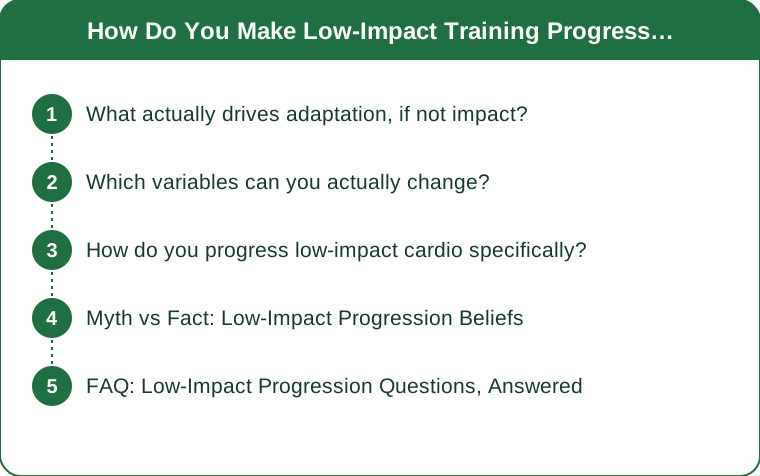
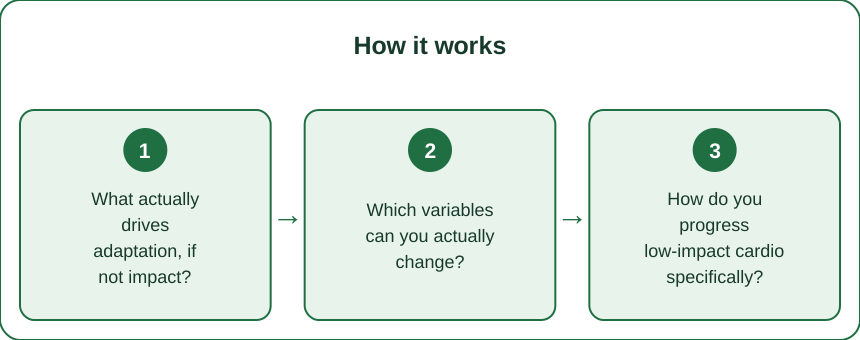
What actually drives adaptation, if not impact?
Mechanical tension, metabolic stress, and progressive challenge over time. Impact is not on the list.
Mechanical tension is the primary driver of muscular adaptation, and it comes from force production against resistance. A slow, heavy leg press produces high tension with zero impact.
Metabolic stress comes from sustained effort and accumulated fatigue within a set. Cycling intervals produce enormous metabolic stress with no ground contact at all.
Cardiovascular adaptation requires elevated cardiac output over time, which any modality can produce. A rowing machine raises cardiac output as effectively as running.
Where impact does contribute uniquely: bone density responds specifically to high-magnitude, rapidly applied loads, which is why impact activity has particular value for skeletal health. This is a genuine and specific gap in a fully impact-free programme.
The workaround for bone, if impact is not available: heavy resistance training does stimulate bone, particularly loaded compound movements, and is the best available substitute. Progressively heavier squats, deadlift variations, and loaded carries are the ones with evidence behind them.
So the honest position: low impact can drive muscular, metabolic, and cardiovascular adaptation as well as high impact. For bone specifically, heavy loading is the substitute, and it is a reasonable one.
Which variables can you actually change?
Six, in rough order of how much they deliver.
1. Load. Add weight. The most direct route to more mechanical tension, and the one most under-used in low-impact settings because those settings often lack heavy equipment. Dumbbells, a loaded backpack, a heavier band, or a machine all count.
2. Tempo. Slow the eccentric to 4 seconds, add a 2-second pause at the hardest position, control the concentric. A bodyweight squat at 4-2-2 tempo is a genuinely hard exercise. This is the most available variable when you have no equipment, and the most under-used overall.
3. Range of motion. Deeper squats, longer step-ups, full overhead reach. Increased range means more work per rep and more tension in lengthened positions, which is particularly effective for hypertrophy.
4. Stability and base of support. Two legs to one leg roughly doubles the load per limb. Add an unstable surface and the demand shifts toward control. Split stance, staggered stance, single leg, and single arm are all progressions.
5. Density, meaning rest reduction. Same work in less time raises metabolic and cardiovascular demand. Cutting rest from 90 to 45 seconds transforms a strength session into a conditioning session.
6. Volume. More sets and more total reps, which drives adaptation and has the lowest ceiling before it just costs time.
How to combine them: change one variable at a time, and hold the others constant for two to four weeks. Changing three at once means you cannot tell what worked, and it usually means too large a jump.
A worked example, over 12 weeks, on a step-up:
- Weeks 1 to 3: bodyweight, 3 sets of 10 per leg, normal tempo
- Weeks 4 to 6: same, with a 3-second lowering phase
- Weeks 7 to 9: add dumbbells, return to normal tempo, 3 sets of 8
- Weeks 10 to 12: higher box, dumbbells, 3-second lowering, 3 sets of 6
By week 12 that is a substantially harder exercise, with no impact anywhere in it.

How do you progress low-impact cardio specifically?
By the same logic, applied to intensity rather than load.
On a bike, rower, elliptical, or incline treadmill:
- Increase resistance at the same cadence, which is the load equivalent
- Increase duration at the same intensity
- Add intervals. The single biggest change available. Structured hard efforts with recovery raise both top-end and aerobic capacity in a way steady state does not.
- Reduce recovery between intervals across weeks
- Increase incline on a treadmill or gradient on a bike, which raises demand without adding speed or impact
A concrete interval progression on a bike:
- Week 1: 6 intervals of 1 minute hard, 2 minutes easy
- Week 3: 6 intervals of 1 minute hard, 90 seconds easy
- Week 5: 5 intervals of 2 minutes hard, 2 minutes easy
- Week 7: 4 intervals of 4 minutes hard, 3 minutes easy
Incline walking deserves specific mention as the most underrated low-impact conditioning tool available. At 12 to 15 percent incline, walking produces heart rates comparable to running at a fraction of the joint load, and it is progressible simply by raising the gradient.
Track something. Watts on a bike or rower, incline and speed on a treadmill, or heart rate at a fixed workload. Without a number, progression becomes a feeling, and feelings drift downward over months.
Myth vs Fact: Low-Impact Progression Beliefs
Myth: Low impact means low intensity. Fact: Impact describes ground reaction force, not effort. A hard rowing interval is among the most demanding things you can do and involves no impact at all.
Myth: You cannot build real muscle without heavy impact work. Fact: Hypertrophy is driven by mechanical tension and volume, neither of which requires impact. Machine and cable work builds muscle effectively, and impact plays no role in the mechanism.
Myth: Bodyweight training cannot progress once you can do a lot of reps. Fact: Tempo, range, and stability all remain available. A single-leg squat with a 4-second lowering phase and a pause is a hard exercise regardless of how many bodyweight squats you can do.
Myth: If it does not feel hard on your joints, it is not working. Fact: Joint discomfort is not a measure of training stimulus. It is a measure of joint load tolerance, which is a separate thing you should be managing, not maximizing.
Myth: Low-impact training is only for people who are injured or older. Fact: Plenty of high-level athletes use low-impact modalities for the bulk of their conditioning volume specifically to manage total loading. It is a tool for managing stress, not a concession.
Myth: You need to change your programme frequently to keep progressing. Fact: The opposite is usually the problem. Repeating a session while progressively increasing one variable is what drives adaptation. Changing exercises every week prevents you from ever progressing any of them, and it is the most common reason low-impact training stalls.
Seasonal note: this is the point in the year when outdoor activity starts to reduce for many people and indoor training volume rises. That is an ideal time to set up a 12-week progression with one variable changing every three weeks, because indoor modalities are consistent and measurable in a way that summer outdoor activity is not.
This is general information, not medical advice. If you are training low impact because of a specific injury or condition, follow the guidance you have been given for that condition.
FAQ: Low-Impact Progression Questions, Answered
Can you get stronger with only low-impact training?
Yes. Strength comes from mechanical tension against progressively greater resistance, which has nothing to do with impact. Add load, slow the tempo, and increase range of motion.
How do you make bodyweight exercises harder without adding weight?
Slow the lowering phase to 3 or 4 seconds, add a pause at the hardest point, increase range of motion, and progress toward single-limb versions. Any of these transforms the difficulty.
Does low-impact training help bone density?
Less directly than impact does, since bone responds specifically to high-magnitude rapid loading. Heavy progressive resistance training is the best available substitute and does stimulate bone.
How often should I change my low-impact programme?
Less often than most people do. Keep the exercises and progress one variable every two to four weeks. Constantly changing exercises prevents progression on any of them.
TL;DR:
- Adaptation comes from mechanical tension, metabolic stress, and progression. Impact is not required for any of them.
- Six variables: load, tempo, range of motion, stability, rest reduction, and volume. Load and tempo do the most work.
- Change one variable at a time and hold it for two to four weeks. Changing three at once tells you nothing.
- For cardio, intervals and incline are the biggest levers. Incline walking is the most underrated tool in the category.
The one genuine gap is bone density, where impact has specific value. Heavy progressive resistance work is the substitute, and it is a good one.
Keep Reading
This article is for general informational purposes only and is not medical advice. Always consult a qualified health professional for guidance specific to you.