How Do You Progress a Low Impact Workout Without Adding Impact?
Quick Answer: You progress low-impact training with five levers that have nothing to do with impact: load, tempo, range of motion, stability demand, and density. The most underused is tempo - taking three to four seconds on the lowering phase of an exercise increases the training stimulus substantially at the same weight, with no added joint loading. Change one lever at a time and hold it for two to three weeks before changing another.
The reason low-impact routines stall is almost never the low impact. It is that the only progression most people know is unavailable.

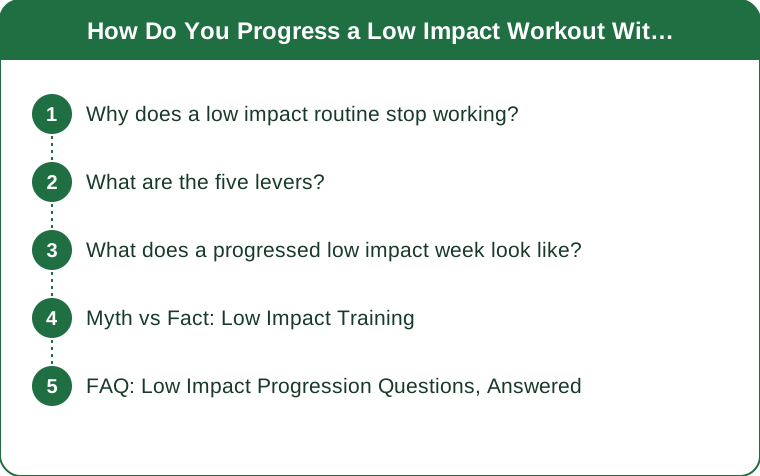
Why does a low impact routine stop working?
Because it stops changing, and adaptation is a response to change.
Your body adapts to a specific stimulus and then maintains. The same 30-minute circuit, at the same pace, with the same resistance, was a challenge in week two and is a maintenance dose by week ten. Nothing broke - the stimulus simply became routine.
Low impact routines stall more often than high impact ones for a structural reason: high-impact training has an obvious progression built in. Run faster, jump higher, add plyometrics. Remove that and most people have no progression model at all.
Intensity is also harder to feel without impact. A hard run announces itself. A hard low-impact session can feel deceptively moderate while producing a genuine training effect, which makes self-regulation by feel unreliable.
And the common response makes it worse. People add duration - 30 minutes becomes 45, then 60. Duration is the weakest progression lever available and it runs out of road fast, because your time is finite and the stimulus per minute is falling.
The reframe: low impact describes the forces through your joints, not the difficulty. A low-impact session can be genuinely hard, and making it hard is a matter of choosing the right lever.
What are the five levers?
In rough order of how much they are underused.
1. Tempo - the most powerful and least used. Slow the lowering phase to three or four seconds. A squat with a 4-second descent is a substantially different exercise than the same squat done at normal speed, because time under tension rises sharply while peak joint force does not. Add a 2-second pause at the bottom and it changes again.
2. Load. Resistance bands, dumbbells, a weighted vest, or simply holding a heavy household object. Load progresses in small increments indefinitely and it is the most conventional lever. A weighted vest is particularly useful because it loads walking, step-ups, and bodyweight work all at once.
3. Range of motion. A deeper squat, a longer lunge step, a push-up with the chest reaching lower. Increasing range increases mechanical work at the same weight - and it usually improves the movement quality at the same time.
4. Stability demand. Two feet to one foot, two hands to one hand, floor to an unstable surface. A single-leg Romanian deadlift with a light dumbbell is far harder than a two-leg version with double the weight, with no impact added.
5. Density. The same work in less time - shorten rests from 90 seconds to 45. This raises cardiovascular demand without raising joint load, and it is the one lever that reliably makes a session feel harder in the way people expect.
Change one at a time. Changing three simultaneously produces a session you cannot repeat and cannot learn from.

What does a progressed low impact week look like?
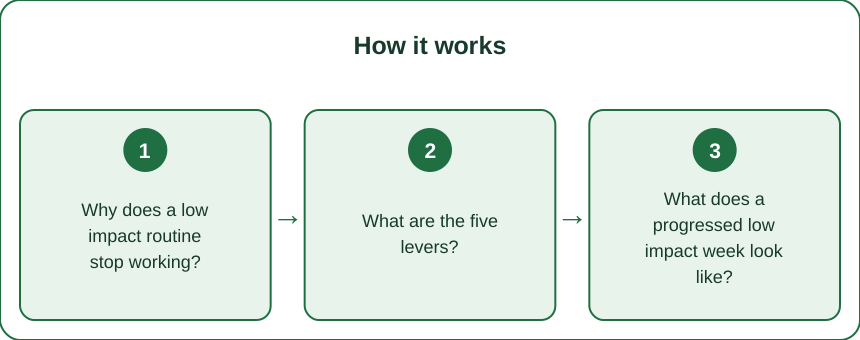
Take the same six exercises and move them along one lever at a time.
Weeks 1 to 3 - establish. Goblet squat 3x10, single-leg RDL 3x8 per side, incline push-up 3x10, band row 3x12, glute bridge 3x15, farmer carry 3x40m. Normal tempo, 90-second rests. Write down the weights.
Weeks 4 to 6 - tempo. Identical weights and reps, but 3 seconds down on every lowering phase. Nothing else changes. Most people find this harder than adding 20 percent to the weight.
Weeks 7 to 9 - load. Return to normal tempo and increase weight roughly 5 to 10 percent where you can. Keep reps the same.
Weeks 10 to 12 - density. Same weights, same reps, rests cut from 90 to 45 seconds. The session gets shorter and considerably harder, and heart rate stays elevated throughout.
Then loop, from a higher baseline. Week 13 starts a new tempo block at week 7’s weights. This is how a low-impact routine keeps producing results in year two, which is roughly when most routines have quietly become maintenance.
Cardio progresses the same way. On a bike or elliptical, progress by resistance at a fixed cadence rather than by duration. A 25-minute session at higher resistance beats a 45-minute session at the same easy setting for both fitness and time cost.
Myth vs Fact: Low Impact Training
Myth: Low impact means low intensity. Fact: Impact describes ground reaction force, not effort. Cycling, rowing, swimming, and heavy resistance training are all low impact and can all be brutally hard. The confusion costs people years of unnecessary plateau.
Myth: You cannot build meaningful strength without heavy loading. Fact: Similar hypertrophy occurs across a wide range of loads when sets are taken close to failure. A moderate load taken genuinely near failure builds muscle - and near-failure is where most low-impact routines fall short, not in the weight selection.
Myth: Low impact does nothing for bone density. Fact: This one has a kernel of truth and an important exception. Impact loading is a strong stimulus for bone, and swimming and cycling are poor bone stimuli. But resistance training loads bone through muscle pull and does increase bone mineral density - so low impact and bone-friendly are compatible if resistance work is included.
Myth: More duration is the way to progress. Fact: Duration is the weakest lever and the one with a hard ceiling. Intensity and density scale far better and cost less of your week.
Myth: Low impact is only for injuries or older adults. Fact: Many well-trained athletes do the majority of their conditioning low impact to manage total joint load while still training hard. It is a load-management choice, not a limitation.
FAQ: Low Impact Progression Questions, Answered
How do I know if my low impact workout is hard enough?
Use an objective marker rather than feel. Either the last two reps of a set should be genuinely difficult, or you should be unable to hold a full conversation during cardio intervals. If both are comfortable, the session is maintenance.
Which lever should I use first?
Tempo, because it is free, requires no equipment, and most people have never used it. A 3-second lowering phase on your existing routine will change how the session feels immediately.
How long should I stay on one lever?
Two to three weeks. Long enough to adapt, short enough that it does not become the new plateau.
Can I build muscle with low impact training?
Yes. Muscle growth depends on mechanical tension and proximity to failure, neither of which requires impact. Resistance training of any load is low impact by definition.
Is low impact enough for bone health?
Resistance training does load bone and does improve density. Pure swimming or cycling does not. If bone health is a goal, include resistance work and, if your joints permit, some walking or light hopping.
What if adding load hurts my joints?
Use tempo, range, and stability instead - all three increase difficulty without increasing peak joint force. If a specific movement causes pain rather than effort, that is a reason to see a physiotherapist rather than to work around it.
TL;DR:
- Low-impact routines stall because the usual progression lever (more impact) is unavailable, not because low impact is limited.
- Five levers replace it: tempo, load, range of motion, stability demand, and density - tempo is the most powerful and the least used.
- Change one lever at a time, hold it two to three weeks, then move to the next and loop from a higher baseline.
- Duration is the weakest lever - progress cardio by resistance at a fixed cadence rather than by adding minutes.
- Low impact can build muscle and bone as long as resistance work is included and sets go close to failure.
The useful shift here is realising that impact was never the source of difficulty - it was just the most obvious dial. Once you have five dials instead of one, a low-impact routine has more room to progress than a high-impact one does.
This is general information, not medical advice.
Keep Reading
This article is for general informational purposes only and is not medical advice. Always consult a qualified health professional for guidance specific to you.