The Gentle Start: A Joint-Friendly Morning Routine for Stiff Days
Quick Answer: A joint-friendly morning routine takes about 10 minutes and moves every hinge gently: in-bed knee hugs, spinal twists and ankle circles, then standing shoulder, hip and knee circles, then counter calf raises and sit-to-stands while the kettle boils. Movement circulates synovial fluid, which is what actually eases stiffness.
Some mornings the joints boot up slowly. The hips load first, the knees buffer, and the back requests a restart.
Stiff mornings want motion delivered gently — not stretching hard, not pushing through, and definitely not going straight from bed to a chair. A bed-to-kitchen sequence oils every hinge before the day makes demands.
Ten minutes, zero force, all lubrication.

Why Are Joints Stiff in the Morning?
Because they’ve been still for eight hours.
Synovial fluid — the joints’ natural lubricant — is thixotropic: it thickens when still and thins when moved. Overnight it becomes more viscous, which is exactly the sensation you’re describing as stiffness. Movement pumps and warms it back to working consistency.
Inflammation adds to this if it’s present, and so does the accumulated shortening of tissues from long sitting. But for most people, most mornings, the fix is simply motion, gently and early.
Which is why the routine starts before you’re even out of bed.
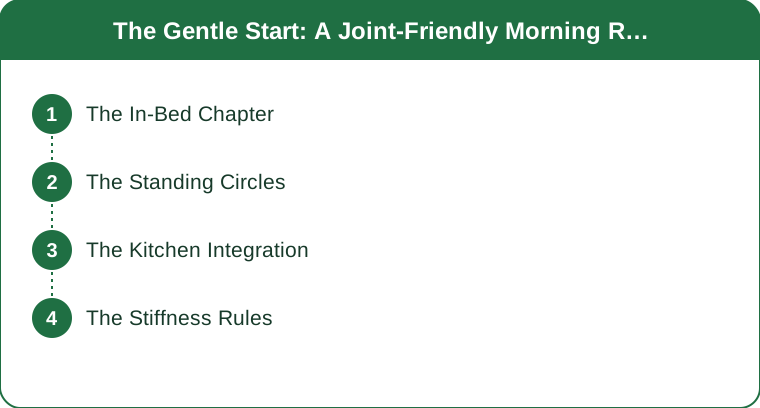
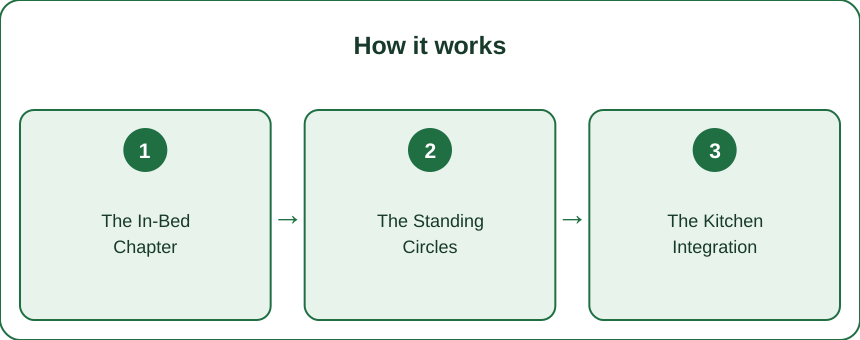
The In-Bed Chapter (3 minutes)
Before standing:
- Knee hugs, alternating — bring one knee toward your chest, hold 15 seconds, swap. 4 each side.
- Gentle spinal twists — knees bent, feet down, let both knees drop slowly to one side, then the other. 8 slow reps.
- Ankle circles under the covers — 10 each direction, each foot.
- Pelvic tilts — flatten the low back gently into the mattress, release. 10 reps.
The bed chapter starts the pumps before gravity arrives, and it’s the part that makes standing up feel less like a negotiation.
The Standing Circles (4 minutes)
Do these by a window, so the light does its circadian work at the same time.
- Shoulder rolls — 10 backward, 10 forward, slow
- Hip circles like a lazy hula — 10 each direction
- Knee circles with hands resting on knees, feet together — 10 each direction, small
- Wrist rotations — 10 each direction
- Neck rotations — slow half-circles, chin to chest and across. Never roll the head backward.
Every hinge visited, nothing forced. The range you have today is the range today — this is a lubrication routine, not a flexibility session, and pushing into pain works directly against the goal.

The Kitchen Integration (3 minutes)
While the kettle works:
- Counter-supported calf raises — hands on the counter, 15 slow reps
- Sit-to-stands from a kitchen chair — 8 reps, no hands if comfortable, hands if not
- Doorway chest opener — forearm on the frame, step through gently, 30 seconds each side
- Heel-to-toe rocking — 20 slow rocks, ankles and feet waking up
The routine hides inside the coffee ritual, which is the reason it survives past week two. By the first sip, the whole chassis is warm.
Myth vs Fact
Myth: You should stretch hard first thing to loosen up. Fact: Tissues are least compliant right after waking, and aggressive static stretching on cold, stiff joints tends to provoke rather than relieve. Gentle range-of-motion work first; save longer holds for later in the day.
Myth: Morning stiffness means arthritis. Fact: Brief morning stiffness is extremely common and mostly normal physiology, especially after desk-heavy weeks or an active day before. Duration is the useful signal, not presence — see below.
Myth: Rest is what stiff joints need. Fact: For the everyday kind, the opposite. Movement is what circulates the fluid that reduces stiffness; sitting still extends it. Gentle and frequent beats intense and occasional.
Myth: Cracking sounds mean damage. Fact: Painless clicks and pops during morning movement are generally gas bubbles and tendons moving over bone — unremarkable. Pain, swelling or locking accompanying the sound is a different story.
When Should You See a Professional?
Morning stiffness easing within about 30 minutes is normal physiology.
Book an appointment if stiffness:
- Lasts more than an hour most mornings
- Comes with swelling, warmth or redness in the joint
- Involves the same small joints on both sides (hands, feet) — a pattern worth investigating
- Is accompanied by fatigue, fever or unexplained weight loss
- Follows an injury, or brings pain that wakes you at night
Those patterns belong to a clinician, not a routine. Inflammatory arthritis is far more manageable when it’s caught early, so the appointment is genuinely worth making rather than waiting out another month.
Mini FAQ
How long before I notice a difference?
Most people feel a same-morning improvement immediately — the routine works on that morning’s stiffness. The cumulative effect, where mornings start out less stiff in the first place, generally shows up after 2–3 weeks of daily practice.
Can I do this if I have arthritis?
Gentle range-of-motion work is usually encouraged for osteoarthritis, and it’s a common recommendation for stiff mornings. That said, run the specific routine past your doctor or physio first, especially if you have inflammatory arthritis or a joint replacement — they may want to adjust which movements you do.
Does heat help before the routine?
For many people, yes. A warm shower or a heat pack for 5–10 minutes before moving makes the whole sequence more comfortable. Cold is generally more useful after activity or for swelling, not for morning stiffness.
TL;DR:
- Morning stiffness is mostly synovial fluid thickening overnight; movement re-thins it.
- Start in bed: knee hugs, spinal twists, ankle circles, pelvic tilts (3 min).
- Stand by a window: shoulder, hip, knee, wrist and neck circles (4 min).
- Finish at the kettle: calf raises, sit-to-stands, doorway chest opener (3 min).
- Stiffness over an hour, with swelling or warmth, or in matched joints — see a doctor.
Bed twists, window circles, kettle calf raises. Stiff mornings never needed force. They needed a maintenance lap, and it fits entirely inside the time the coffee takes anyway.
Keep Reading
This article is for general informational purposes only and is not medical advice. Always consult a qualified health professional for guidance specific to you.