Does Low-Impact Training Still Work When You Stop Feeling Sore?
Quick Answer: Soreness is a poor measure of training effectiveness, and its disappearance is usually a sign of adaptation rather than of a plateau. Delayed onset muscle soreness comes largely from unfamiliar movement and eccentric loading - so it fades as your tissue adapts to a movement, even while that movement continues to build fitness.
What actually indicates progress: the load, reps, duration, or difficulty is increasing over time, and your heart rate at a given effort is falling. If those numbers are moving, it is working, however you feel the next day.
Here are the questions that follow from that, answered in order.

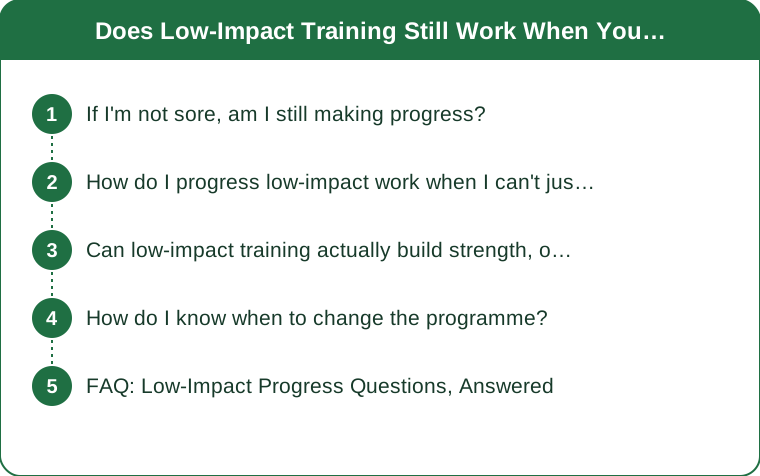
If I’m not sore, am I still making progress?
Almost certainly yes, and soreness was never the right measure.
What soreness actually reflects. DOMS is primarily caused by microscopic damage from unfamiliar movements, especially eccentric loading - the lowering phase. It is a novelty response. The first week of anything produces it; the sixth week of the same thing does not.
Why it fades even when training is effective. The repeated bout effect is well documented - after a few exposures to a movement, the same session produces markedly less damage. Your tissue got better at handling it, which is the adaptation you were training for. Complaining about the absence of soreness is complaining that the training worked.
What the research says about the relationship. Studies comparing soreness with hypertrophy and strength gains do not find a reliable link. Sessions producing enormous soreness do not produce proportionally more adaptation, and some of the most effective training protocols produce very little.
What to measure instead:
- Load, reps, or time increasing over weeks - the only genuinely reliable indicator
- Heart rate at a fixed effort falling - a clear cardiovascular adaptation signal
- Recovery speed between intervals improving
- The session feeling easier at the same numbers
The honest caveat: if nothing is progressing and nothing is sore, that is a plateau - but the plateau is visible in the numbers, not in how you felt on Tuesday.
How do I progress low-impact work when I can’t just add impact?
Progressive overload has at least six variables, and load is only one. Low-impact training has all the others available.
The levers, in rough order of how easily they apply:
- Range of motion. A deeper squat, a longer step-up, a fuller press. More range at the same load is more work, and it is the most underused variable
- Tempo. Three seconds down instead of one roughly triples time under tension for the same weight. This is the most efficient progression available without adding load
- Pauses. A two-second pause at the hardest point removes elastic assistance and makes a light weight genuinely demanding
- Load. Bands, dumbbells, a weighted vest for walking. Still available in low-impact training - low impact refers to ground reaction force, not to how heavy things are
- Density. Same work, less rest. This shifts the stimulus toward conditioning
- Stability. Single leg, single arm, or an unstable surface. A split squat is dramatically harder than a squat at the same total load
- Volume. More sets. Effective and the slowest to fatigue you
The key misunderstanding worth naming: low impact does not mean low intensity. A slow tempo split squat with a two-second pause is a brutally hard exercise with almost no joint impact. People conflate the two constantly and then conclude low impact cannot be challenging.
A practical progression rule: change one variable at a time and hold it for two to three weeks. Changing three at once means you learn nothing about what worked.

Can low-impact training actually build strength, or only maintain it?
It builds strength, and the evidence on this is fairly clear - what matters is load and proximity to failure, not whether your feet leave the ground.
What actually drives strength adaptation:
- Mechanical tension on the muscle - which comes from load and range, not from impact
- Proximity to failure - sets taken within a few reps of failure drive adaptation, and this is achievable with bands, bodyweight, and dumbbells
- Progressive increase over time
None of those require impact. A heavy dumbbell split squat, a slow tempo push-up, or a banded row can all be taken close to failure with essentially zero joint impact.
What low impact genuinely cannot replace:
- Bone density loading. Bone responds to impact and to heavy load. Low-impact training with heavy resistance still delivers the load component; swimming and cycling deliver neither. This is a real consideration, particularly around and after menopause
- Reactive power and tendon stiffness. Plyometric qualities need plyometric work. If you need to jump, land, and change direction, low impact alone will not prepare you
- Running-specific durability. Only running builds tolerance for running
Which suggests the sensible position: low impact can be the entire strength and conditioning programme for most goals, and if bone density is a concern, adding some loaded carrying, heavy resistance work, or gentle impact is worth discussing with a clinician - particularly if you have been told you have low bone density. This is general information, not medical advice.
How do I know when to change the programme?
Change when the numbers stop moving, not when the sensation changes. Those are different events and people confuse them constantly.
The signals that genuinely warrant a change:
- Three to four weeks with no progression on any variable. Not one bad week - a sustained flat line across load, reps, tempo, and heart rate
- Heart rate at a given effort has stopped falling after previously improving
- The session no longer feels challenging even at the top of your rep range
- You are avoiding the session, which is often the earliest honest signal
The signals that do not warrant a change:
- No soreness. Covered above - this is adaptation
- One flat week. Sleep, stress, cycle phase, and heat all produce single bad weeks that mean nothing
- Boredom alone. Worth addressing, and it is a motivation problem rather than a programming one - changing a working programme to relieve boredom often costs you the progression
What to change, and in what order:
- First, add a variable rather than replacing exercises. Slow the tempo or add a pause before you overhaul anything
- Then progress load or range
- Only then change exercise selection, and change one or two rather than the whole session
And keep a record. The single most useful habit in low-impact training is writing down the numbers, because the changes are gradual enough to be invisible without them. You will not remember what you did six weeks ago, and six weeks ago is exactly the comparison that answers the question.
FAQ: Low-Impact Progress Questions, Answered
Should I deliberately introduce new exercises to get sore again?
Novelty produces soreness and does not produce more adaptation, so chasing it usually costs you the progression you had built on familiar movements. Rotate exercises every 8 to 12 weeks for variety and joint health, not to manufacture next-day discomfort.
Why am I sore after a session I have done for months?
Usually something changed - a deeper range, more reps, a different surface, or simply being underslept. It is also common after a break of even one week, since the repeated bout effect fades faster than most people expect.
Is low-impact cardio enough for cardiovascular fitness?
Yes, and the intensity is what matters rather than the impact. Cycling, rowing, incline walking, and swimming can all reach the intensities that drive VO2 max, and the elliptical often gets a higher heart rate than people expect precisely because the arms are involved.
How long before I see visible changes?
Strength changes appear in the numbers within 4 to 6 weeks and visible changes usually take 12 or more. This is why tracking numbers matters - the mirror lags far behind the adaptation and will tell you nothing useful in the meantime.
TL;DR:
- Soreness reflects unfamiliarity, not effectiveness, and it fades because your tissue adapted
- Track load, reps, tempo, and heart rate at a fixed effort - those tell you if it is working
- Progress low impact with range, tempo, pauses, stability, density, and load - not just weight
- Low impact builds real strength; it cannot replace impact for bone density or reactive power
- Change the programme after three to four flat weeks, not because nothing hurts
Open your training notes and compare this week’s numbers with six weeks ago. That comparison answers the question soreness never could.
Keep Reading
This article is for general informational purposes only and is not medical advice. Always consult a qualified health professional for guidance specific to you.