Can You Build Real Muscle With Only Low-Impact Training?
Quick Answer: Yes — muscle growth depends on progressive resistance and mechanical tension, not on impact, so low-impact strength training with bands, machines, or controlled bodyweight work can build real muscle as long as you progressively increase the challenge over time.

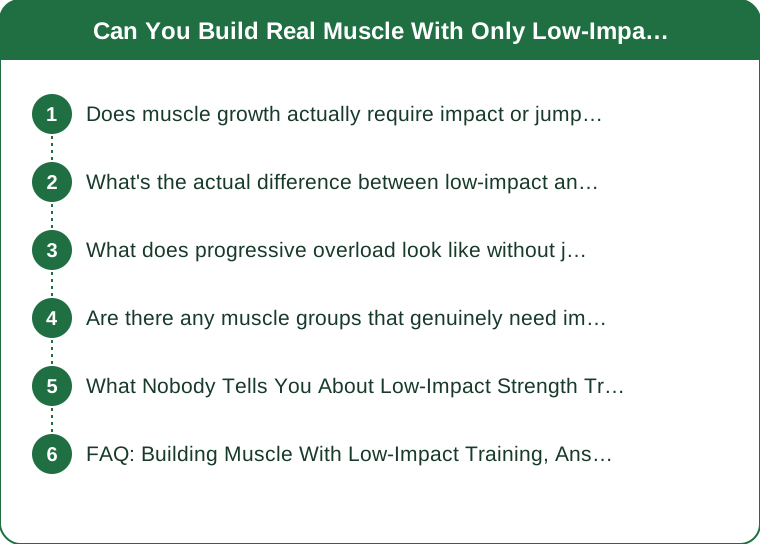
Does muscle growth actually require impact or jumping movements?
No. Muscle hypertrophy is driven by mechanical tension, metabolic stress, and progressive overload — none of which require your joints to absorb impact forces. A controlled squat, a slow leg press, or a resistance band row can create the same tension on the muscle fibers as a jumping or explosive version, just without the joint-jarring landing.
What’s the actual difference between low-impact and low-intensity?
This is the confusion that trips up most people: low-impact refers to force absorbed by joints on landing or striking, while intensity refers to how hard the muscle is working. A slow, weighted step-up is low-impact but can be extremely high-intensity for your quads and glutes. You can absolutely make a low-impact session brutal by increasing resistance, slowing tempo, or reducing rest.
What does progressive overload look like without jumping or running?
The same principles apply: add weight, add reps, slow the tempo, or reduce rest between sets. A resistance band bicep curl becomes harder with a heavier band or a 4-second lowering phase, not by turning it into a plyometric movement. Tracking these variables over weeks is what drives adaptation, regardless of impact level.

Are there any muscle groups that genuinely need impact training to develop fully?
Explosive power output — the kind sprinters or jumping athletes need — does benefit from some plyometric or impact-based training, since power is a specific, trainable quality distinct from pure size or strength. But for general muscle size and strength, which is what most people training at home or in a gym actually want, impact isn’t a requirement.
What Nobody Tells You About Low-Impact Strength Training
Most people assume low-impact automatically means gentle or beginner-level, but some of the hardest resistance training protocols are entirely low-impact — slow eccentric-focused lifting, isometric holds, and heavy machine work all qualify. The ‘low-impact equals easy’ assumption is often what keeps people from progressing, because they never push the resistance hard enough to actually stimulate growth.
FAQ: Building Muscle With Low-Impact Training, Answered
How long does it realistically take to see muscle growth from low-impact training?
Most people notice visible changes in 8-12 weeks of consistent progressive resistance training, 2-4 sessions per week, regardless of whether the training is low-impact or not.
Do you need heavy weights to build muscle with low-impact methods?
No — bands, bodyweight, and machines can all create sufficient tension when you control tempo and push close to muscular fatigue, though very advanced lifters eventually benefit from heavier external load.
Is low-impact strength training a good option for people with joint issues who still want to build muscle?
Yes, this is often the ideal approach, since it removes the jarring forces that aggravate joints while still providing the mechanical tension muscles need to grow.
TL;DR:
- Muscle growth needs mechanical tension and progressive overload, not impact
- Low-impact and low-intensity are different things — you can make low-impact training very hard
- Add weight, reps, tempo, or reduce rest to progress without jumping
- Explosive power is the one quality that benefits from impact training specifically
If your low-impact sessions feel too easy, the impact level isn’t the problem — the resistance and progression are.
Keep Reading
This article is for general informational purposes only and is not medical advice. Always consult a qualified health professional for guidance specific to you.