Can Low-Impact Training Really Replace Running for Cardiovascular Fitness?
Quick Answer: For cardiovascular fitness specifically, yes — low-impact options like cycling, swimming, and elliptical training can produce comparable aerobic benefits to running when matched for intensity and duration. The main difference is bone density stimulus, where running’s impact provides an advantage low-impact training doesn’t replicate.
Running isn’t the only path to real cardiovascular fitness, but it isn’t fully interchangeable with low-impact alternatives either — the honest answer depends on which specific benefit you’re after.

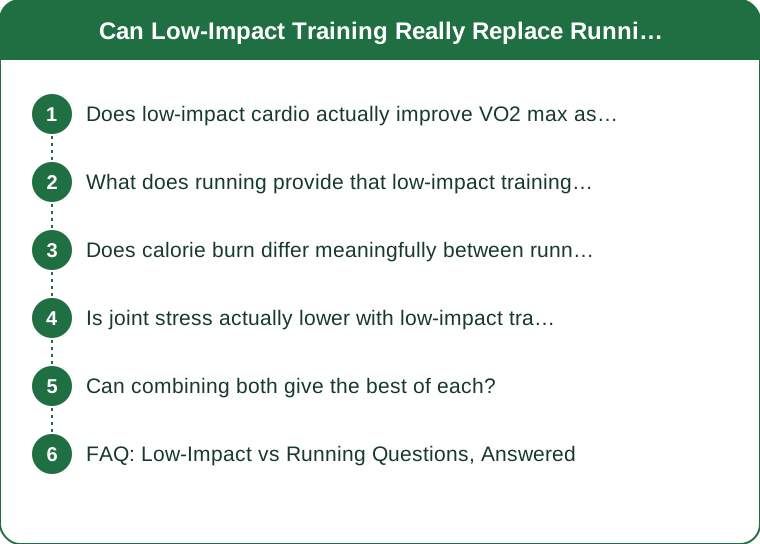
Does low-impact cardio actually improve VO2 max as well as running?
Studies comparing cycling, swimming, and running at matched exertion levels generally find similar improvements in VO2 max and cardiovascular capacity, meaning the heart and lung adaptations don’t require high-impact movement specifically.
What does running provide that low-impact training doesn’t replicate?
Running’s repeated impact loading stimulates bone density in a way that non-weight-bearing low-impact activities like swimming and cycling don’t match, which matters more for long-term bone health than for cardiovascular fitness itself.
Does calorie burn differ meaningfully between running and low-impact options?
At matched perceived exertion and duration, calorie burn is broadly comparable, though running can allow for higher peak intensity in a shorter time for people who can tolerate the impact, giving it a slight edge in time efficiency for some.

Is joint stress actually lower with low-impact training?
Yes — this is the core tradeoff: low-impact options substantially reduce repetitive joint loading, making them a better option for people managing joint issues or recovering from injury, without necessarily sacrificing cardiovascular benefit.
Can combining both give the best of each?
Many coaches recommend mixing running with low-impact cross-training specifically to get some bone-loading benefit from running while reducing total joint stress through lower-impact sessions on other days.
FAQ: Low-Impact vs Running Questions, Answered
Is swimming as effective as running for weight loss specifically?
Swimming can support weight loss effectively when duration and intensity are matched, though some people find it easier to sustain higher perceived exertion running, affecting total calorie burn per session.
Should someone with joint issues avoid running entirely?
Not necessarily — it depends on the specific issue and severity, and a professional’s input is valuable, but low-impact alternatives are a reasonable default when joint stress is a concern.
Does age change which option is better?
Older adults often benefit from prioritizing low-impact options to manage cumulative joint stress, while still needing some form of weight-bearing activity for bone health specifically.
TL;DR:
- Low-impact cardio can match running’s cardiovascular and VO2 max benefits when intensity is matched
- Running’s main unique advantage is bone density stimulus from impact loading
- Calorie burn is broadly similar; running may allow higher peak intensity in less time
- Combining both captures cardiovascular benefit while managing total joint stress
Low-impact training is a legitimate substitute for cardiovascular fitness specifically, though not a full one-to-one replacement for every benefit running provides.
Keep Reading
This article is for general informational purposes only and is not medical advice. Always consult a qualified health professional for guidance specific to you.