Can Low-Impact Training Alone Actually Get You in the Best Shape of Your Life?
Quick Answer: Yes, for most fitness goals — strength, cardiovascular health, muscle definition, and fat loss can all be achieved through low-impact training alone. The main exception is sport-specific power and impact tolerance for activities like running or jumping sports, which do benefit from some impact exposure.
High-impact training earned its reputation partly because it’s efficient, not because it’s uniquely necessary. Low-impact training can build real strength, real cardiovascular capacity, and real muscle — with some specific exceptions worth knowing about.

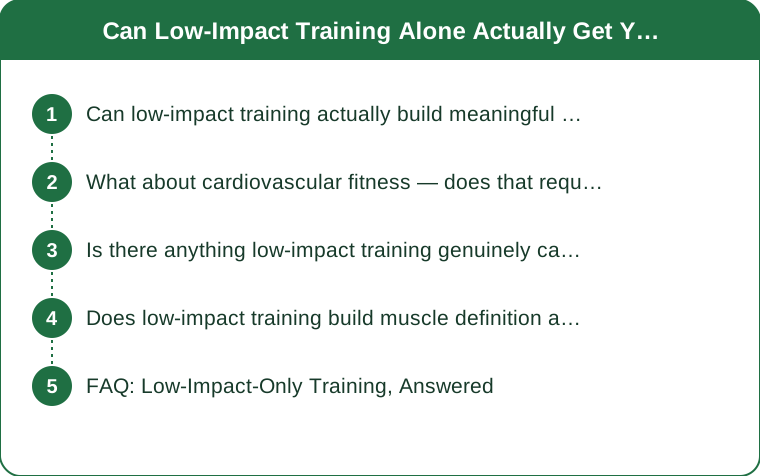
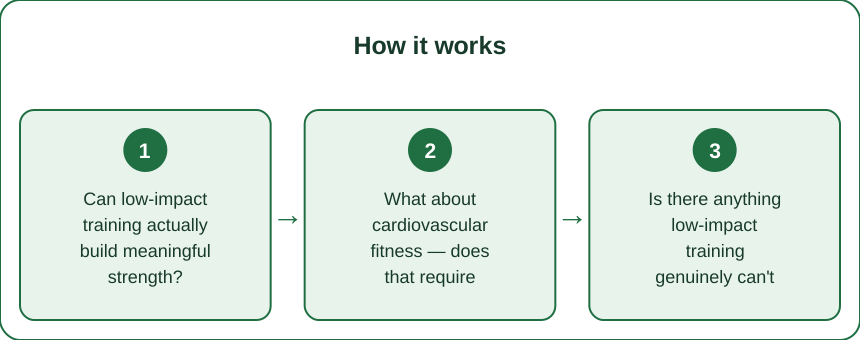
Can low-impact training actually build meaningful strength?
Yes — strength adaptation depends primarily on progressive overload (gradually increasing resistance, reps, or difficulty), not on impact. Resistance bands, dumbbells, cables, and bodyweight progressions all provide plenty of overload potential without any joint impact, and strength research consistently shows comparable strength gains between impact and non-impact resistance training when overload is matched.
What about cardiovascular fitness — does that require impact too?
No — cardiovascular adaptation responds to sustained elevated heart rate, which low-impact activities like cycling, swimming, rowing, and incline walking achieve just as effectively as running or jumping-based cardio. Some of the most rigorous cardiovascular endurance research actually comes from cycling and rowing studies, both fundamentally low-impact modalities.

Is there anything low-impact training genuinely can’t replicate?
Yes, one specific thing: impact tolerance and bone density stimulus specific to weight-bearing, high-impact movement. If a goal involves actual running, jumping sports, or activities with real-world impact demands, some impact training is genuinely useful for preparing the body’s tissues for that specific stress — this is a training-specificity issue, not a general fitness limitation of low-impact work.
Does low-impact training build muscle definition as effectively?
Yes, for the most part — muscle hypertrophy responds to mechanical tension and training volume, both of which are fully achievable without impact. The visible difference in physique between high- and low-impact-trained individuals usually comes down to overall training volume and consistency, not the impact factor itself.
FAQ: Low-Impact-Only Training, Answered
Is low-impact training a good long-term strategy, or just a temporary injury workaround?
It’s a completely legitimate long-term strategy for most goals — many people choose it permanently for joint longevity, not just as a temporary injury accommodation.
Will I plateau faster with low-impact training than high-impact?
Not inherently — progressive overload, not impact, is what prevents plateaus, so a well-programmed low-impact routine progresses just as effectively as a high-impact one.
Should I add any impact work at all if I’m generally healthy?
For general fitness, it’s optional — but if bone density or a specific impact sport is a personal goal, some controlled impact exposure (even light jumping) provides a specific stimulus low-impact training doesn’t fully replicate.
TL;DR:
- Strength, cardiovascular fitness, and muscle definition are all fully achievable with low-impact training alone
- Progressive overload and sustained heart rate — not impact — drive most fitness adaptations
- The main exception is impact tolerance and bone density stimulus specific to high-impact sports
- Low-impact training is a legitimate permanent strategy, not just an injury workaround
For almost every general fitness goal, low-impact-only training holds up fully — it’s a specificity question, not a limitation.
Keep Reading
This article is for general informational purposes only and is not medical advice. Always consult a qualified health professional for guidance specific to you.