Can Low-Impact Training Actually Build Strength, or Just Maintain It?
Quick Answer: Yes, low-impact training builds real strength, because strength adaptation responds to mechanical tension and progressive overload — not to impact. What low-impact training does not do on its own is develop the tendon stiffness and bone loading that plyometric work provides. If you are not getting stronger on a low-impact program, the problem is almost always missing progression, not missing impact.
There is a persistent belief that low-impact means low-intensity, and that low-intensity means maintenance only.
The first half is false. The second half is true but irrelevant, because low-impact training can be extremely intense.
Here is what actually determines whether your program builds anything.

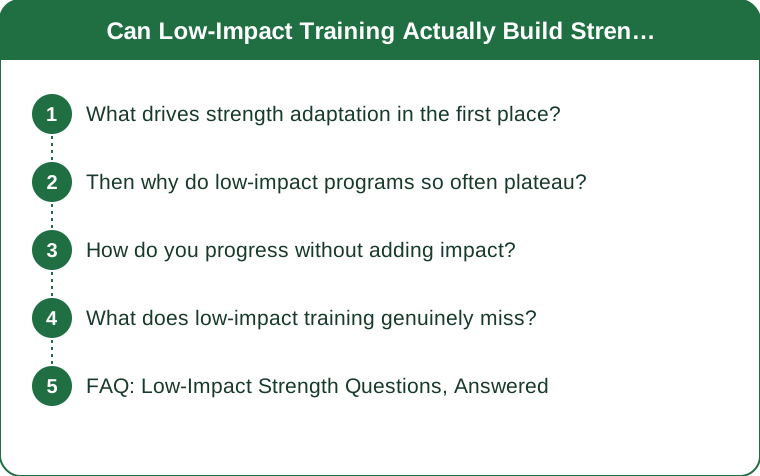
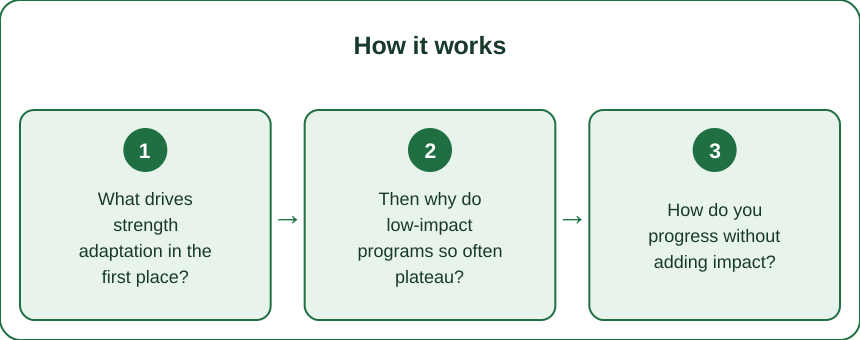
What drives strength adaptation in the first place?
Mechanical tension on the muscle, applied progressively over time. That is the primary driver, and impact is not part of the equation.
A slow, controlled leg press at a challenging load produces high mechanical tension with essentially zero impact. A set of jumping jacks produces high impact and relatively low mechanical tension. The first builds strength; the second builds other qualities.
What matters:
- Load relative to your capacity. Sets taken reasonably close to failure — roughly one to three reps in reserve — drive adaptation regardless of movement speed
- Progressive overload. More weight, more reps, more sets, better range, or slower tempo over weeks
- Sufficient volume. Roughly 10 or more hard sets per muscle group per week is a commonly cited working range for growth
- Recovery between sessions for the same muscle
Notice that none of these mention impact, jumping, or speed. You can hit every one of them in a fully low-impact program.
Then why do low-impact programs so often plateau?
Because low-impact formats — especially class-based ones — frequently have no progression mechanism built in.
Common culprits:
- The same weights every week. A class that has used 5-pound dumbbells for a year is a maintenance program. This is by far the most common cause.
- Rep counts driven by music rather than effort. Sets end when the song ends, not when the muscle is close to failure
- Endless variety. Constantly changing exercises prevents you from tracking whether anything improved, and progression requires a baseline
- Effort that never approaches failure. Comfortable is pleasant and produces little adaptation
The fix is the same in every case: pick a small set of movements, track them, and make them harder over time. Not more complicated — harder.
If your Tuesday class is identical to last February’s Tuesday class, no amount of consistency will produce strength. That is a program design problem, and it is completely fixable within a low-impact framework.

How do you progress without adding impact?
Six levers, all fully compatible with joint-friendly training. Rotate through them:
- Add load. The most straightforward. Heavier dumbbell, heavier band, more resistance on the machine
- Add reps at the same load until you hit the top of your target range, then add load and drop back down
- Slow the tempo. A four-second lowering phase dramatically increases time under tension without any additional weight — one of the most useful tools in low-impact work
- Increase range of motion. A deeper split squat is harder than a shallow one at the same load
- Reduce the base of support. Two legs to one leg roughly doubles the load on the working limb with no extra equipment
- Add pause reps. A two-second pause at the hardest position removes elastic assistance entirely
For example, a step-up progression across twelve weeks: bodyweight to a low box, then a higher box, then holding dumbbells, then slower tempo, then a pause at the top, then heavier dumbbells. All low impact, and a large strength increase.
Write it down. Progression without a log is guessing, and guessing is where plateaus come from.
What does low-impact training genuinely miss?
Being honest about the gaps matters, because they are real even though they are not about strength.
Bone density loading. Bone responds strongly to high-magnitude, rapid loading — impact. Heavy resistance training does load bone meaningfully, and it is the best low-impact option available for this. But if you have specific bone density concerns, that is worth a conversation with a clinician about whether any impact work is appropriate for you.
Tendon stiffness and reactive strength. The ability to absorb and return force quickly is trained by plyometrics and running, and it does not develop from slow controlled work. This matters for athletic performance and for real-world tasks like catching yourself on a stumble.
Peak aerobic capacity, if all your cardio is genuinely low intensity. Low-impact does not have to mean low-intensity — cycling, rowing, and incline walking can all reach high intensity — but many low-impact routines drift toward easy by default.
The practical response is not to abandon low-impact training. It is to know which gap applies to you and address it deliberately: heavy resistance work for bone, and if your joints allow, small doses of low-level reactive work like fast walking with brief pickups or gentle hops on a soft surface.
This is general information, not medical advice — if you are training low-impact because of a specific condition, discuss any changes with your clinician.
FAQ: Low-Impact Strength Questions, Answered
Can I build muscle with bands and bodyweight alone?
Yes, particularly in the first year or two, as long as you progress systematically — harder variations, more reps, slower tempo, less assistance. Eventually external load becomes the simpler way to keep progressing.
Is Pilates or barre enough for strength?
They build meaningful endurance, control, and often noticeable strength for beginners, but most class formats lack a load-progression mechanism. Adding two short resistance sessions weekly covers what they miss.
How do I know if I am progressing?
Keep a log of two or three key movements. If the load, reps, or tempo has improved over eight weeks, you are progressing. If the numbers are identical, you are maintaining — which is a fine goal, just a different one.
TL;DR:
- Strength comes from mechanical tension and progressive overload, not from impact
- Most low-impact plateaus are missing progression, not missing jumping
- Progress with load, reps, tempo, range, stability, or pauses — and log it
- Real gaps: tendon stiffness, reactive strength, and some bone-loading stimulus
Pick two movements and write down what you did today. In eight weeks the log will tell you definitively whether your program builds or maintains. General information, not medical advice.
Keep Reading
This article is for general informational purposes only and is not medical advice. Always consult a qualified health professional for guidance specific to you.