Can Low-Impact Cardio Really Replace HIIT? Here's What the Evidence Says
Quick Answer: For fat loss and general cardiovascular fitness, low-impact cardio done consistently and for sufficient duration produces comparable results to HIIT in most studies — the main difference is time efficiency, not effectiveness ceiling. HIIT wins on time-per-session; low-impact wins on joint sustainability and adherence for many people.
HIIT gets the spotlight and low-impact cardio gets treated like the consolation prize. But when you actually look at what the research compares — not just marketing claims — the picture is a lot more balanced than the fitness-content hierarchy suggests.

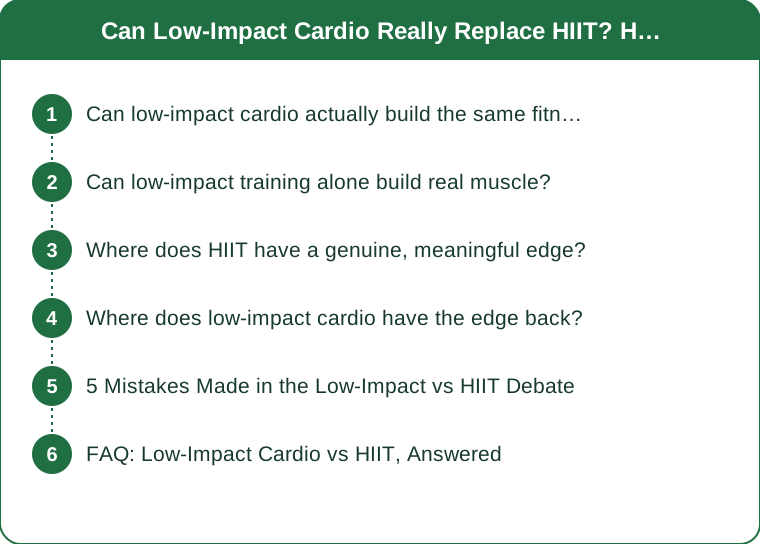
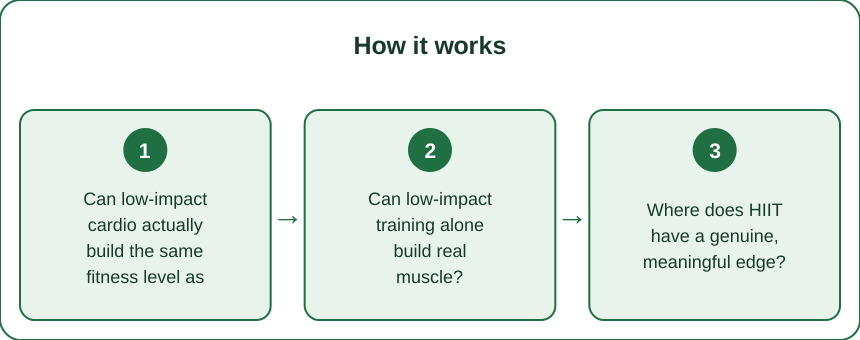
Can low-impact cardio actually build the same fitness level as HIIT?
For most standard fitness markers — VO2 max improvement, resting heart rate reduction, and fat loss — studies comparing moderate-intensity steady-state cardio against HIIT over equal total training time find comparable results in the majority of trials. The gap that does exist tends to favor HIIT slightly on VO2 max gains per minute of exercise, but low-impact cardio done for longer durations closes most of that gap.
Can low-impact training alone build real muscle?
Not to the same degree as resistance training, and this applies to HIIT too — neither low-impact cardio nor HIIT is a strong muscle-building stimulus on its own. If muscle retention or growth is a goal alongside cardio fitness, resistance training needs to be added regardless of which cardio style you choose; this isn’t a point in HIIT’s favor over low-impact.
Where does HIIT have a genuine, meaningful edge?
Time efficiency is HIIT’s real, well-documented advantage. A 20-minute HIIT session can produce cardiovascular adaptations that would take 40-60 minutes of steady low-impact work to match. If total available training time is the binding constraint, HIIT is the more efficient choice per minute — that’s a real and repeatedly replicated finding, not marketing.

Where does low-impact cardio have the edge back?
Joint stress and recoverability. HIIT’s high-force, high-impact nature means more recovery demand and higher injury risk for people with joint sensitivity, larger body sizes, or return-from-injury status. Low-impact cardio can be done daily with minimal recovery cost, which for many people translates into more total weekly training volume — and consistency, not any single session’s intensity, is usually what drives long-term results.
5 Mistakes Made in the Low-Impact vs HIIT Debate
1. Comparing unequal total time. A 15-minute HIIT session against 15 minutes of walking isn’t a fair fitness comparison — match total time or total effort, not just minutes.
2. Assuming low-impact means low effort. Steady-state cardio pushed to a genuine moderate-to-vigorous heart rate zone is real training, not a warm-up.
3. Ignoring joint history when choosing. Someone with knee issues chasing HIIT trends can end up injured and training zero, which beats no plan compared to low-impact done consistently.
4. Treating it as all-or-nothing. Most well-rounded programs use both — HIIT for time-efficient intensity, low-impact for volume and recovery days.
5. Skipping resistance training regardless of cardio choice. Neither cardio style substitutes for strength work if muscle and bone density are goals.
FAQ: Low-Impact Cardio vs HIIT, Answered
Is walking as effective as HIIT for weight loss?
For calorie expenditure per minute, no — HIIT burns more per minute. But for total weekly calorie burn, someone walking daily for 45 minutes can match or exceed someone doing three 20-minute HIIT sessions, depending on consistency.
Do you lose cardiovascular fitness gains if you switch from HIIT to low-impact?
No — fitness adaptations transfer between modalities reasonably well; the training stimulus (elevated heart rate over time) matters more than the specific method.
Is it better to alternate between HIIT and low-impact cardio each week?
Many well-designed programs do exactly this — it balances time efficiency with joint recovery, and adds variety that supports long-term adherence.
TL;DR:
- Low-impact cardio matches HIIT on most fitness markers when total time is equal
- HIIT’s real advantage is time efficiency, not a higher fitness ceiling
- Low-impact cardio is easier on joints and supports more total weekly volume
- Neither replaces resistance training for muscle or bone density goals
This is general information, not medical advice — check with a professional if you’re returning from injury. The honest answer: pick based on your joints, your schedule, and what you’ll actually do consistently, not the workout with the flashier reputation.
Keep Reading
This article is for general informational purposes only and is not medical advice. Always consult a qualified health professional for guidance specific to you.